

Tree Trimming in Beloit, WI
Expert tree trimming and pruning across Beloit, South Beloit, and the Rock River corridor. Our ISA Certified Arborists follow ANSI A300 standards to protect Beloit's mature canopy — from heritage oaks near the college to ornamental and fruit trees throughout Rock County.
Financing available — low monthly payments
Watch Spider Lift Tree Work in Beloit
A spider lift — a compact tracked aerial platform that fits through a standard residential gate — is the right tool for Beloit's tight-lot mature canopy near Beloit College and the Rock River corridor, where a full-size bucket truck can't position. ANSI A300-standard pruning from a stable platform, with the tracked base spreading weight to protect the lawn.
Read transcript
This video shows our crew using a spider lift for tree work on a Beloit, Wisconsin property. A spider lift is a compact, tracked aerial work platform — its outrigger legs deploy like a spider's, and its narrow tracked base fits through a standard residential gate, typically 36 inches. It's the right tool when access matters more than raw reach.
Beloit's older neighborhoods near Beloit College and along the Rock River corridor have exactly the conditions a spider lift is built for: mature canopy on tight lots, trees set behind fences or between structures where a full-size bucket truck can't position, and ground that needs protecting. The tracked base spreads the machine's weight to limit lawn damage, and the outriggers stabilize the platform so the arborist can work aloft safely.
From the platform, the arborist performs the same ANSI A300-standard pruning we'd do from a climbing line or a bucket — crown cleaning to remove dead and broken wood, crown thinning to reduce wind load, crown raising for clearance, and structural pruning to correct weak branch attachments. The lift simply gives a stable, efficient working position in spaces that would otherwise require a full climbing setup. For removals, it positions the arborist to make controlled rigging cuts where the tree can't be safely climbed.
Tree Wise Men LLC runs spider lift, bucket truck, crane, and full climbing rigging out of our Janesville headquarters, 15 minutes north of Beloit. ISA Certified Arborists, TCIA Accredited, ANSI A300-compliant pruning on every job across Rock County.
Why Proper Pruning Matters for Beloit Trees
Beloit's older neighborhoods — Big Hill, Bluff, Riverside, Eastside — have some of the most valuable mature canopy in Rock County. Many of these trees were planted in the late 1800s and early 1900s as the city grew alongside its industrial heritage. Improper trimming — topping, lion-tailing, flush cuts, over-pruning — causes irreversible damage to trees that took a century to grow. Our ISA Certified Arborists follow science-based pruning practices that protect long-term tree health and structural integrity.
Mature Canopy in Older Neighborhoods
Big Hill, Bluff, and the streets surrounding Beloit College have specimen oaks, maples, and elms 80–150 years old. These mature trees need careful crown cleaning, deadwood removal, and weight reduction — not aggressive cutting. We preserve the architecture that took generations to develop.
Oak Wilt Pressure in Rock County
Rock County has significant oak wilt activity. We only prune oaks during the safe dormant window — November through March — when sap beetles are inactive. Spring and summer pruning creates fresh wounds that attract the beetles carrying oak wilt spores, a mistake that can kill mature oaks within weeks.
Riverside & Floodplain Trees
Trees along the Rock River and Turtle Creek face repeated flooding that saturates soil and weakens root anchorage. These trees often need preventive structural pruning to reduce wind sail area and weight reduction to compensate for compromised roots. Skipping this work invites storm-driven failure.
Crown Reduction Done Right
When a tree has outgrown its space — common in Beloit's tighter older lots — proper crown reduction reduces canopy size by cutting back to adequate lateral branches. Unlike topping, which creates weak regrowth and decay, proper reduction maintains the tree's natural form and structural integrity.
Fruit & Ornamental Tree Care
Apple, pear, cherry, and plum trees throughout Beloit need annual pruning for maximum fruit production. Late winter (February–March) is the ideal pre-bud-break window. Crabapples, Japanese maples, and other ornamentals need species-specific pruning to preserve their natural form and aesthetic value.
Seasonal Timing for Wisconsin
Wisconsin's climate creates specific pruning windows. Dormant season for most species (November–March), after bloom for spring-flowering trees, late summer for minimal regrowth, and year-round for deadwood and hazards. Our arborists schedule each species at its optimal time, even if it means returning in a different season.
Types of Professional Pruning We Perform in Beloit
Crown Cleaning
Removal of dead, dying, diseased, and broken branches throughout the canopy. The most common and most important pruning type — it reduces pest habitat and eliminates branches likely to fall during Wisconsin's spring and summer storms. Recommended every 3 to 5 years for mature Beloit shade trees.
Crown Thinning
Selective removal of interior branches to increase light penetration and air circulation without changing the tree's overall shape. Reduces wind resistance during storms common across the Rock River valley, promotes interior growth, and helps prevent fungal diseases in humid summers.
Crown Raising
Removal of lower branches to provide clearance for sidewalks, vehicles, structures, and sight lines. Common along Beloit streets where mature canopy has grown to obstruct pedestrians or driveways. We maintain proper branch-to-trunk ratios to preserve tree stability.
Structural Pruning
Correcting branch architecture in young and maturing trees to develop strong structure. We identify and address co-dominant stems, included bark, and weak attachments before they become structural failures. Particularly valuable for trees planted in newer Beloit developments where early intervention pays off for decades.
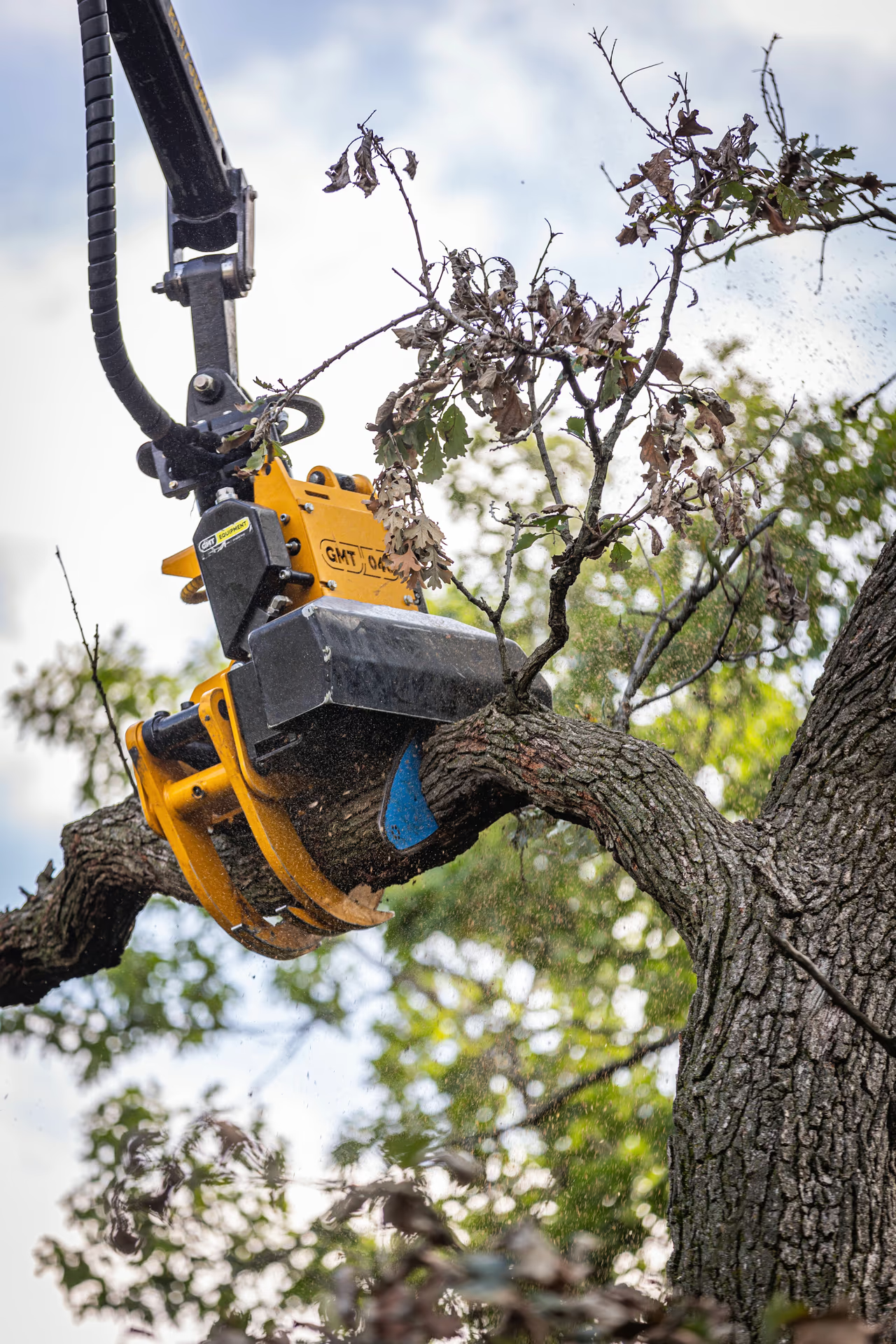
Crown Reduction vs. Topping: Know the Difference
Many Beloit homeowners are pitched topping by unqualified companies. Topping is malpractice — it destroys trees and creates years of expensive structural problems. Here's how our ISA Certified approach is different.
Proper Crown Reduction
Cuts are made back to lateral branches at least one-third the diameter of the branch being removed. The tree retains its natural form, wound closure proceeds efficiently, and any regrowth is structurally sound. Canopy size decreases without compromising the tree's health, vigor, or long-term integrity.
Why Timing Matters
Pruning during the dormant season reduces stress, minimizes sap loss, and avoids the insect-vectored diseases — especially oak wilt — active in Rock County during the warm months. We schedule each species at its optimal window, even when that means returning to a property in a different season.
The Science Behind Pruning Cuts
Every pruning cut is made just outside the branch collar — the slightly swollen ring where branch meets trunk. This preserves the tree's natural defense zone and allows the wound to seal properly. Flush cuts and stub cuts both compromise this defense, leading to internal decay that may not become visible for years.
Annual Maintenance Programs
For Beloit properties with multiple mature trees, we offer annual maintenance programs that cycle through your trees on a species-appropriate schedule. Regular professional pruning extends tree life, reduces storm damage risk, and maintains property values. Many Beloit homeowners with established canopy schedule us annually.
Beloit's Tree Trimming Specialists
Tree Wise Men LLC has been pruning trees across Beloit and Rock County since 2010. With 4 ISA Certified Arborists on staff, full TCIA accreditation, and a 30+ person crew operating from our Janesville headquarters just 15 miles north, we have the expertise and capacity to maintain trees of any size on any Beloit property — from Eastside bungalows to Big Hill estates.
Call us at (608) 751-4171 for a free trimming estimate anywhere in Beloit, South Beloit, or surrounding Rock County.
Tree & Property Services Across Beloit & Rock County
Explore our other Beloit-specific tree care pages — each covers the local permits, species, and neighborhood access that matter for your property.
Tree Trimming FAQs for Beloit
Common questions about tree trimming and pruning in Beloit, WI.
When is the best time to trim trees in Beloit?
Most deciduous trees in Beloit are best pruned during the dormant season — late November through March — when the tree's structure is visible and disease transmission risk is lowest. Oak trees in Rock County must only be pruned in the November–March window because of oak wilt pressure; pruning between April and October exposes wounds that attract sap beetles carrying the fungus. Spring-flowering ornamentals like crabapples and magnolias should be pruned immediately after blooming. Deadwood removal and emergency hazard pruning can be performed any time of year.
Do you serve Beloit from your Janesville headquarters?
Yes. Our headquarters on County Rd O in Janesville is about 15 miles north of Beloit — a 20-minute drive — so we run jobs in Beloit and South Beloit daily. The short commute means same-week scheduling for most non-emergency work and rapid emergency response. We've been pruning trees in Beloit and along the Rock River corridor since 2010.
How much does tree trimming cost in Beloit?
Tree trimming in Beloit typically ranges from $250 for small ornamentals to $1,500+ for mature canopy trees needing crane access or extensive deadwood removal. Pricing varies with tree size, species, scope, and access difficulty — older neighborhoods like Big Hill and Bluff with mature canopy and tight lot lines often need more rigging, which adds to cost. We provide free on-site estimates with detailed written proposals.
Why shouldn't I trim my oak trees in spring or summer?
Pruning oaks between April and October in Wisconsin exposes fresh wounds that attract sap beetles (Nitidulidae), which carry oak wilt fungal spores. Oak wilt is fatal to red oaks and can spread through root grafts to neighboring oaks. Rock County, including Beloit, has documented oak wilt outbreaks. The safe pruning window for oaks in Beloit is November through March, when sap beetles are dormant and the fungus is inactive.
Can you prune trees near the Beloit College campus?
Yes. The Beloit College area has some of the most valuable mature tree canopy in Rock County — oaks, maples, and elms approaching 100+ years old in adjoining residential neighborhoods. We coordinate with property owners on College Avenue, Bushnell Street, and the surrounding blocks for crown cleaning, deadwood, and structural pruning. Estate-grade trees deserve estate-grade pruning practices.
Can you trim trees along the Rock River in Beloit?
Yes. Properties along the Rock River from Riverside Park through downtown Beloit and out toward Turtle Creek often have mature trees on saturated soil and steep banks. These trees frequently need preventive structural pruning and weight reduction because compromised root anchorage from flooding makes them more susceptible to wind throw. We use specialized rigging on riverbank pruning jobs to protect both the tree and adjacent properties.
Can you trim fruit trees in Beloit?
Yes. We prune apple, pear, cherry, and plum trees throughout Beloit and Rock County. Fruit tree pruning focuses on opening the canopy for light and air circulation, removing crossing branches, maintaining productive fruiting wood, and managing tree height for easier harvesting. The best window for fruit tree pruning in Beloit is late winter (February–March) before bud break.


2026 guide
Wondering what removal would run instead? 2026 Beloit removal costs by size and neighborhood.
Need Tree Trimming in Beloit?
Get a free on-site consultation with an ISA Certified Arborist. We'll evaluate your trees, recommend the right pruning approach, and provide a detailed written estimate with no hidden fees.