Your May Tree Care Checklist for Southern Wisconsin Yards
May is a turning point for trees in Southern Wisconsin. The cold-snap risk that defines April is mostly behind us, the soil has warmed enough for active root growth, and most species have either pushed leaves or are about to. It is also the month when several care decisions become urgent, not optional. Below is the checklist our ISA Certified Arborists at Tree Wise Men LLC walk through on May estimates across Rock, Dane, Walworth, and Jefferson counties.
Inspect every mature tree from the ground up
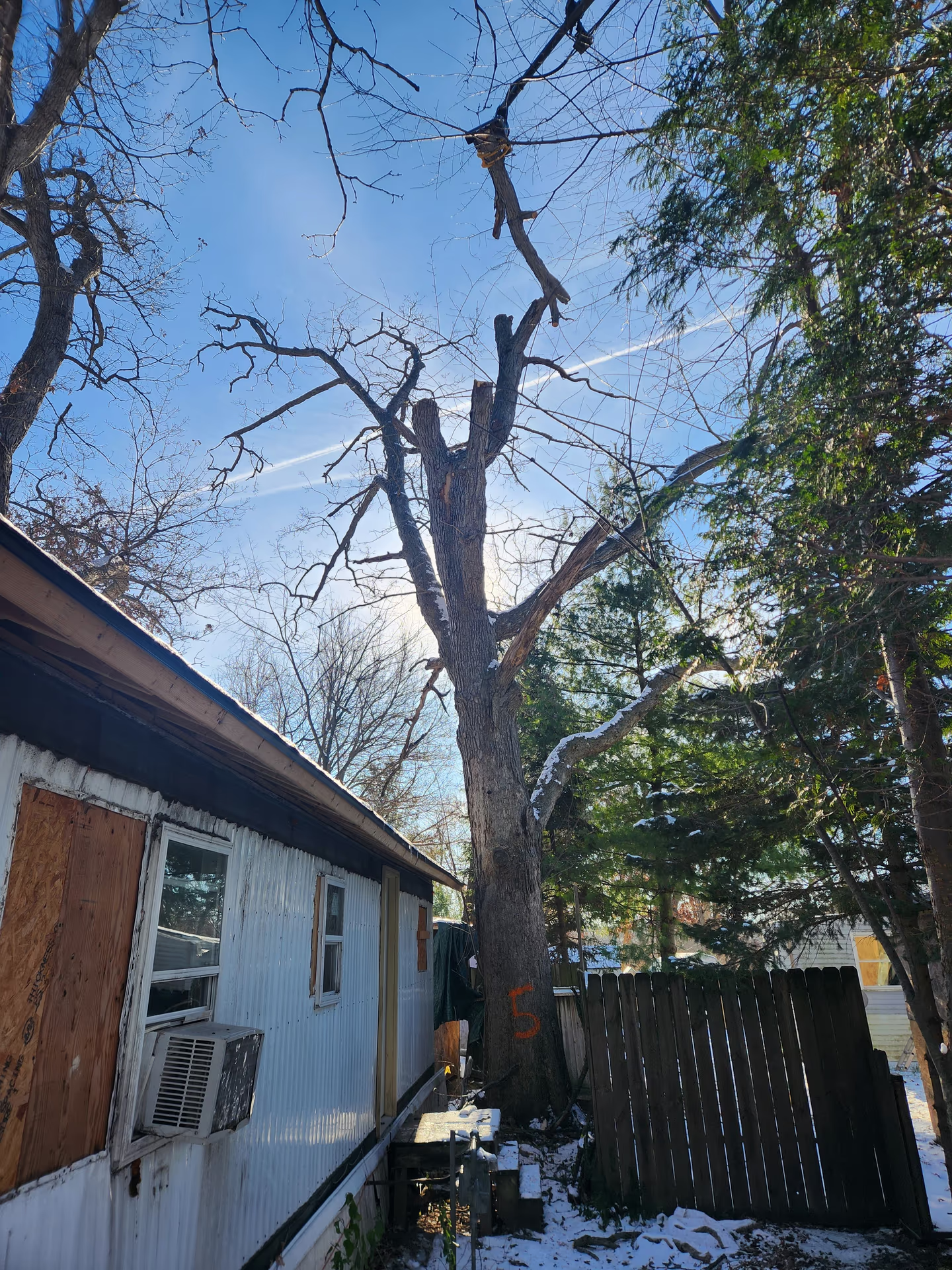
Spend ten minutes per tree, ideally in the morning when low light shows texture changes on the bark. You are looking for four things. First, root flare and base — fresh soil mounding, exposed roots that were buried last fall, fungal conks at the soil line, or visible decay pockets. Second, trunk — vertical cracks from winter freeze, woodpecker activity (which often signals borers underneath), and any new lean compared to last year. Third, scaffold branches — broken or hanging limbs from the heavy spring snows we typically see in March and early April, weak crotches with included bark, and large dead branches over walkways or roofs. Fourth, canopy fill-in — by mid-May, healthy oaks, maples, and ash should be showing strong leaf push. Sparse or one-sided canopies are a red flag worth a professional assessment.
Take photos of anything that looks off. Comparing them to last May's photos is the cheapest tree health diagnostic available.
Water newly planted trees, even when it rains
Trees planted in the past two years have not yet established the deep, wide root systems that mature trees use to ride out dry stretches. Wisconsin springs are increasingly variable — a wet April followed by a dry May is a common pattern, and the dry stretch hits new plantings hardest because their roots are still concentrated in the original root ball.
The rule for newly planted trees is one to two inches of water per week, delivered slowly to the root zone, every week from May through September. A single deep soak is better than daily light watering — it pushes roots to grow downward instead of staying near the surface. A simple way to deliver this is a five-gallon bucket with a couple of small holes drilled in the bottom; set it next to the trunk, fill it twice a week, and let it drain through.
Mulch — but do not volcano-mulch
May is mulch season across Southern Wisconsin. The right approach is two to four inches of wood chip or shredded bark mulch in a wide ring extending out toward the dripline, with mulch pulled back several inches from the trunk so air reaches the bark. The wrong approach is a tall cone piled against the trunk — the so-called volcano. Volcano mulching keeps bark wet, invites decay fungi, and creates a moist channel for rodent damage in winter. We see trees declining from this every year.
If your existing mulch ring has compacted into a hard mat, scratch the surface with a rake to break up the crust before adding new material. That keeps water and air moving through the mulch layer instead of running off.
Watch the oak pruning window close
This is the single most important calendar item for Wisconsin oak owners. The safe pruning window for any oak species in Southern Wisconsin closes April 1 and stays closed through October. Pruning between these dates exposes fresh wounds that attract sap beetles in the family Nitidulidae. Those beetles carry oak wilt fungal spores from infected red oaks, and a single beetle on a single fresh cut is enough to introduce the disease.
If you have oak work to do, finish it in the next few days, or wait until November. The only exception is emergency hazard work — a storm-damaged limb that has to come down for safety — and even then we apply tree wound paint to the cut immediately to seal the entry point.
Schedule plant health care while injection conditions are right
Trunk-injection treatments work best when trees are actively transpiring and moving water through their vascular system. In Southern Wisconsin that window is roughly mid-April through late June. Two of the most common treatments fall in this period: emamectin benzoate injections for emerald ash borer protection on healthy ash trees, and propiconazole injections for oak wilt protection on high-value red oaks near confirmed infection sites.
If you have an ash tree you intend to save, the May–June window is when treatment delivers the strongest two- to three-year protection. Treating later in the summer still works but with reduced uptake. If you have an oak in a neighborhood with confirmed oak wilt within a few hundred feet, May is also the right time to assess whether preventive treatment is warranted.
Plan removals before the storm season
Trees that were marginal last year — a leaning silver maple, a hollow-trunked maple, an ash with significant canopy decline — are likely a year worse this May. Wisconsin's severe weather corridor delivers straight-line wind events, occasional tornado damage, and increasingly frequent derecho-style storms from late May through September. The cost of a planned, daytime, dry-conditions removal is consistently lower than emergency cleanup after a tree fails.
If a tree on your property has had warning signs — significant lean, large dead branches over a target, root damage from construction, or visible decay — May is the right time to get an arborist out for an honest assessment, not after the storm.
Know when to call
Most of the items above are appropriate for a homeowner with a rake, a bucket, and an eye for detail. The two that are not are oak treatment and risk-rated trees near structures. Those decisions need an ISA Certified Arborist on site — to verify symptoms, evaluate structural integrity, and recommend the right intervention before a small problem becomes a big one.
Tree Wise Men LLC has been serving Southern Wisconsin since 2010. Our team includes four ISA Certified Arborists across our Janesville and Madison offices, and we provide free on-site assessments for anything you find on your May checklist. Call (608) 751-4171 for the Janesville HQ, (608) 716-4167 for the Madison office, or visit treewisemenllc.com/contact-us.