ISA Certified Arborist Serving Beloit, WI
If you've been told to "hire a certified arborist" without much explanation of what that means or why it matters, this guide is for you. The ISA Certified Arborist credential is a real, enforced professional standard — and for anything beyond basic tree removal, it's the difference between getting expert judgment and getting guesswork with a chainsaw.
What ISA Certified Arborist means
The International Society of Arboriculture (ISA) is the global professional body for tree care. Its Certified Arborist credential requires:
- At least 3 years of full-time tree care experience before you can sit for the exam
- Passing a rigorous written exam covering tree biology, soil science, diagnosis, pruning, cabling, installation, safety, and climbing
- 30 hours of continuing education every 3 years to maintain the certification
- Adherence to an enforced code of ethics — arborists can lose certification for misconduct
Certification numbers are public and verifiable. You can look up any ISA Certified Arborist by name or number at treesaregood.org/findanarborist/verify.
The higher credentials
Beyond basic certification, the ISA offers specialized credentials:
- TRAQ (Tree Risk Assessment Qualification) — required to perform formal tree risk assessments for insurance or legal purposes
- Board Certified Master Arborist — the highest ISA credential; requires 10+ years experience and a 400-question exam
- Utility Specialist, Municipal Specialist, Climber Specialist — domain-specific add-ons
Why hiring a certified arborist matters
You're buying expertise, not just muscle
Anyone with a chainsaw can take a tree down. A certified arborist can tell you whether it needs to come down in the first place, what's wrong with it, whether it's salvageable, and — if removal is the right call — how to do it without damaging your property, your neighbor's property, or the people on site.
This matters most when:
- A tree is sick and you don't know why
- A tree is close to power lines, a house, or a septic field
- Multiple trees are showing similar symptoms (disease spread)
- You're buying or selling a property with significant trees
- An insurance claim depends on tree condition
- A construction project requires protecting existing trees
Liability and insurance
Many insurance carriers and municipalities require ISA certification before they'll accept a tree-risk report. A quote or report signed by a certified arborist carries legal weight; one from an uncredentialed "tree guy" generally doesn't. If you're in a dispute with a neighbor over a boundary tree or filing a homeowner's claim on storm damage, certification matters.
Pruning standards
Proper pruning is the single most overlooked tree-care issue in residential Wisconsin. Bad pruning — especially "topping" (the most common mistake in tree care) — ruins structural integrity, invites decay, and shortens tree life by decades. ISA-certified arborists follow ANSI A300 pruning standards. Uncertified crews often don't know those standards exist.
What a certified arborist assesses
Tree health
Canopy condition, leaf density and color, presence of dieback, bud formation, bark health, and signs of disease or pest activity. In Wisconsin this includes screening for oak wilt, Dutch elm disease, emerald ash borer, two-lined chestnut borer, and anthracnose.
Structural condition
Trunk soundness (decay, cavities, conks), branch attachment quality (weak unions, included bark, co-dominant stems), crown symmetry, and lean stability. This is where resistograph or sonic tomography testing may come in for borderline cases.
Site conditions
Root zone health, soil compaction, grade changes, nearby construction damage, drainage, and species-site match. A tree planted in the wrong spot will always fight its environment — recognizing this early lets you adjust before problems compound.
Risk to targets
Targets are what a tree could fall on: people, houses, vehicles, utility lines. A TRAQ-qualified arborist rates failure probability, consequence severity, and overall risk using a published methodology — not just gut feel.
Services that really benefit from a certified arborist
- Tree diagnosis. Why is my tree dying? Proper diagnosis requires training — a lot of look-alike symptoms point to very different causes.
- Tree risk assessment. Formal risk reports for insurance, construction, or pre-sale inspections.
- Structural pruning. Especially on young trees — pruning a 10-year-old tree correctly affects its structure for the next 80 years.
- Cabling and bracing. Saving a salvageable tree instead of removing it.
- Construction damage mitigation. Protecting a tree's root zone during a build or remodel.
- Pest and disease treatment. Diagnosis first, then treatment plan — not the other way around.
For simpler jobs — clear-access removal of a dead pine, grinding a stump — an uncertified crew under certified supervision is fine, and you shouldn't pay certified-arborist rates for non-certified work. But the person who quotes the job and plans it should be certified.
Our Beloit service area and team
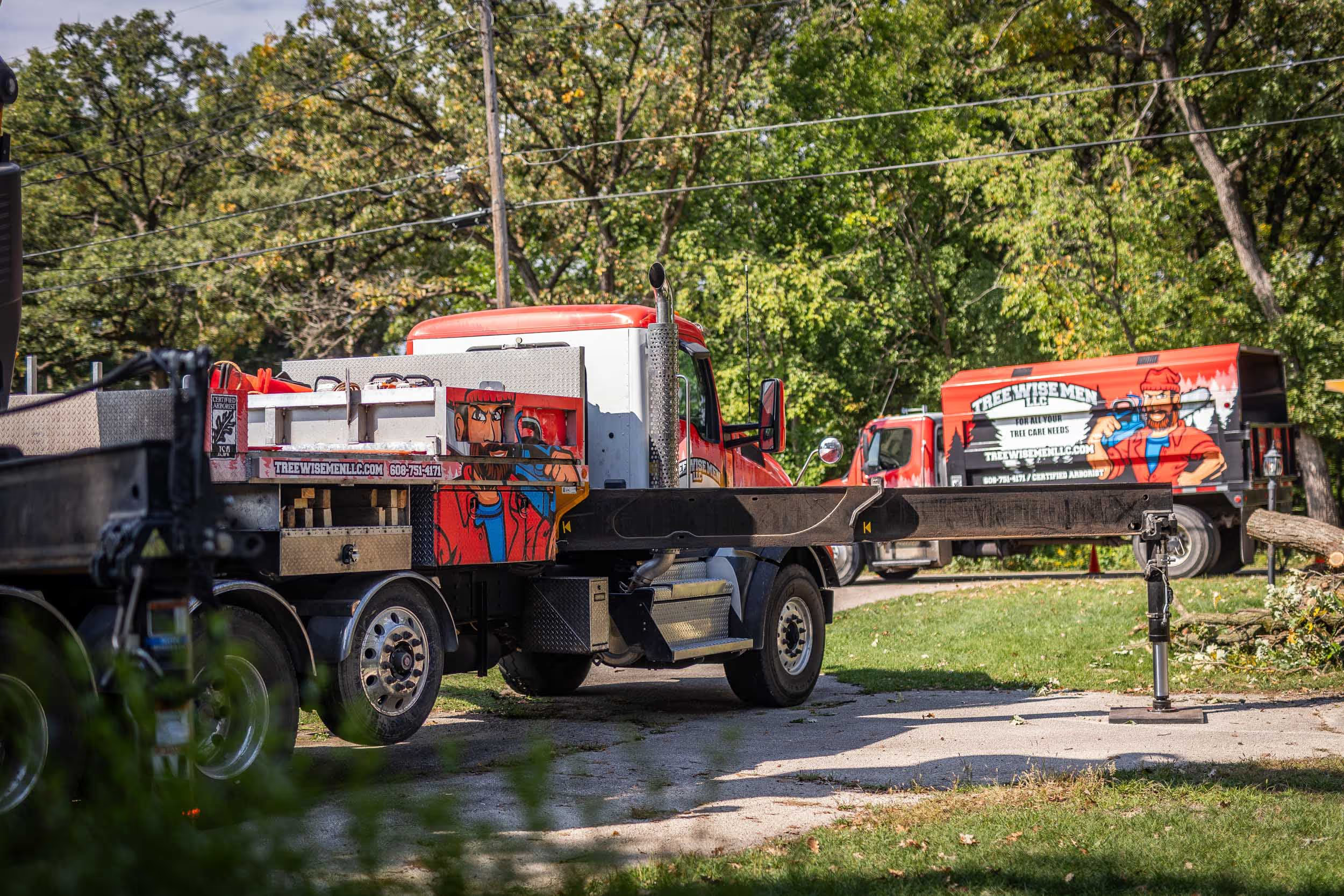
Tree Wise Men serves Beloit and the surrounding area from our base just north in Janesville — we're at 4332 E County Rd O, about 15 minutes from downtown Beloit. We cover all of Rock County including Beloit, South Beloit, Clinton, Orfordville, Shopiere, and the townships along the Rock River.
Our arborists:
- Jason James — Owner, ISA Certified Arborist (WI-1418A). 15+ years in the field. Specializes in large removals, risk assessments, and oak wilt management.
- Andrew — ISA Certified Arborist (WI-1674A). Climber specialist, structural pruning, and mature-tree preservation.
Every estimate we write for Beloit-area customers is walked and quoted by one of us — not a sales rep.
What a certified arborist consultation costs
- Free on-site estimate when you're considering a specific service (removal, pruning, treatment) — the arborist is on-site and can answer questions as part of the visit
- Diagnostic consultation (what's wrong with my tree?): $125–$250 depending on site complexity
- Formal TRAQ Tree Risk Assessment (written report with photos, risk rating, recommendations): $200–$500 per tree
- Pre-construction tree inventory and protection plan for a building project: $400–$1,500 depending on tree count
If you're comparing quotes from multiple tree services, check the certification status of the person signing the quote — not just the company name. It's a 30-second check at treesaregood.org and it tells you whether you're getting trained expertise or guesswork.
How to find a good arborist (even if it's not us)
- Verify certification online before the first visit
- Ask for a certificate of insurance ($2M liability minimum, plus workers comp)
- Check that they'll put the quote in writing with scope, cleanup level, and any exclusions
- Google for reviews — look for specifics about the work, not just "nice guys"
- Avoid door-to-door pitches, especially after storms. Legitimate arborists don't solicit door-to-door.
- Ask about their pruning standard. The answer should include "ANSI A300." If they say "we top trees," walk away.
Ready for an arborist to look at your trees?
Schedule a free on-site consultation in Beloit or anywhere in Rock County. Request an estimate online or call (608) 751-4171. We'll send an ISA Certified Arborist, not a salesperson.