Dangerous & Large Tree Removal Near Homes
Dangerous and large tree removal means taking a leaning, dead, storm-damaged, or oversized tree down in sections beside the house. ISA Certified Arborists use rigging or a crane, and the estimate is free.
Financing available — low monthly payments
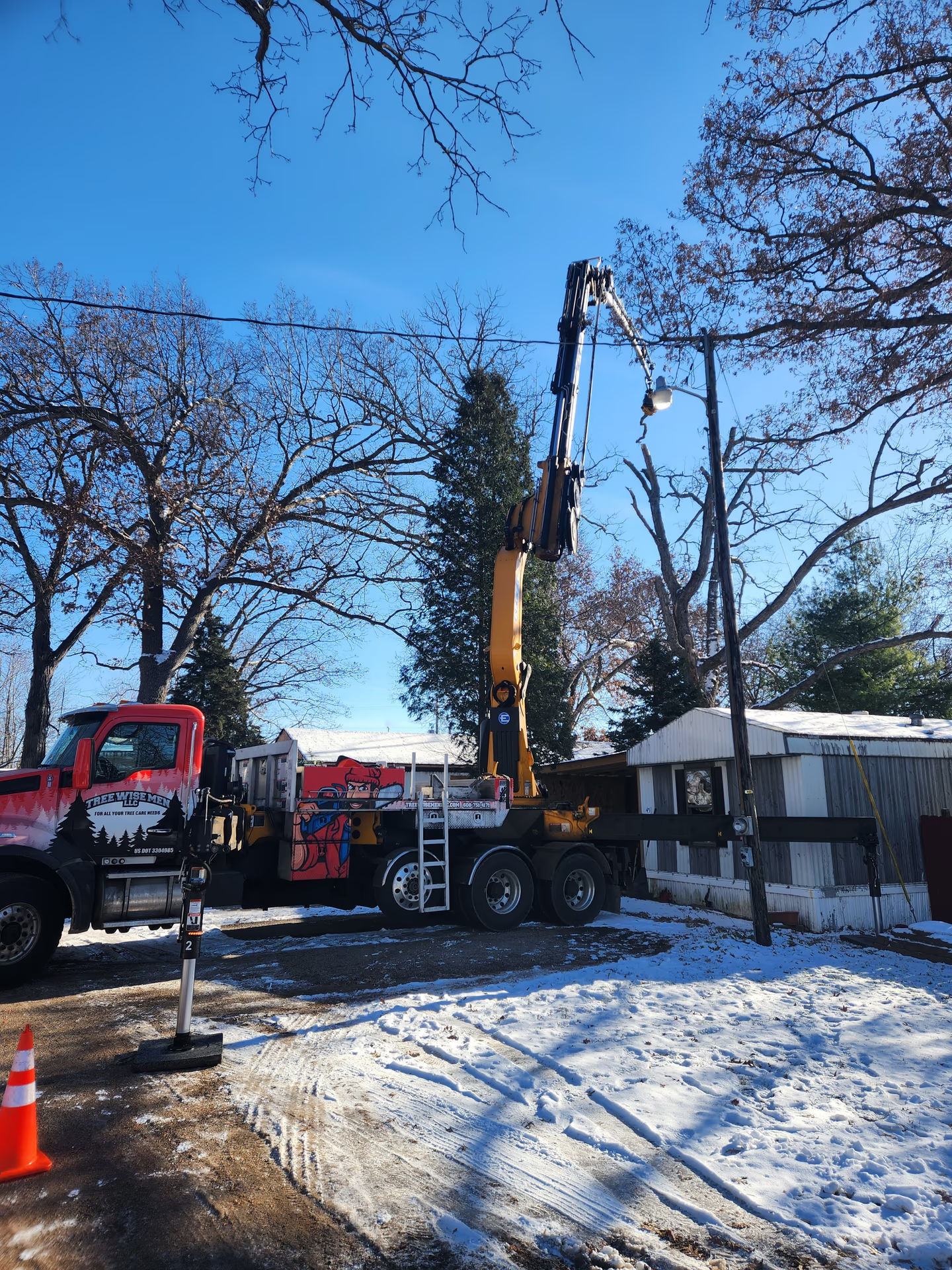
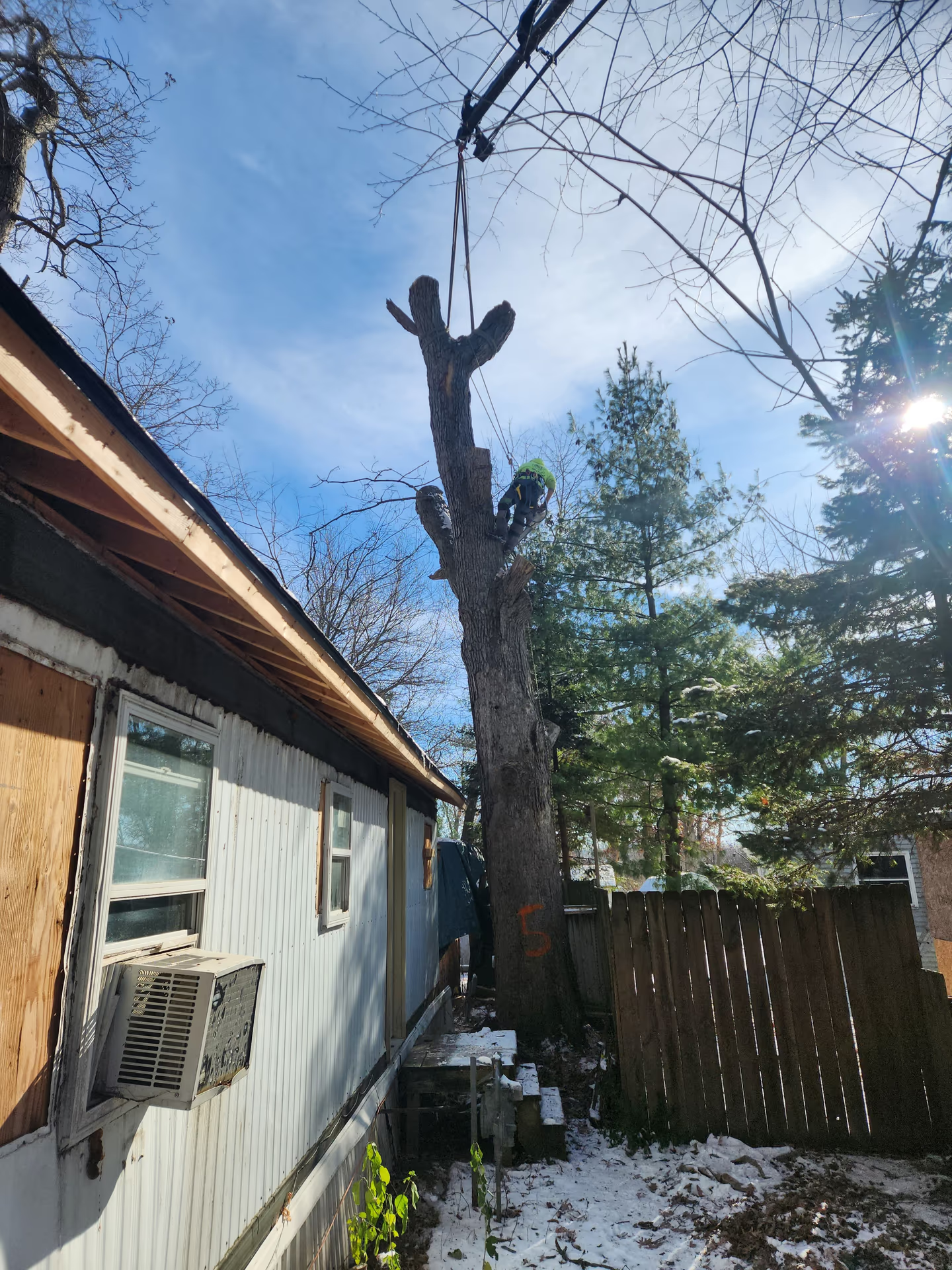
Tight-space tree removal near a home
The kind of removal most companies refuse: large tree, small clearance, structures on every side. Here's our crew making it look routine.
Read transcript
This video documents a high-risk tight-space tree removal — the work where the tree is so close to a structure, so leaning over a target, or so structurally compromised that conventional removal techniques introduce unacceptable risk to the property below.
The work starts with a TRAQ-style risk assessment by a Tree Risk Assessment Qualified arborist. TRAQ is the ISA's advanced credential for tree risk evaluation — the assessor evaluates the tree's structural condition, the load path, the target environment, and the consequence severity of failure during work. The output is a documented risk decision that informs the entire rigging plan. We don't begin work on a high-risk removal without it.
What makes a removal high-risk varies. Sometimes it's proximity — a 70-foot oak six feet from a house corner where every section has to travel through a path that's narrower than the trunk diameter. Sometimes it's the tree's structural condition — advanced internal decay, a recent storm-induced partial failure, a co-dominant stem with included bark that's holding under static load but unpredictable under cutting forces. Sometimes it's both.
The rigging plan accounts for every consequence. Crane assistance lifts sections clear of the target rather than risking lowering them through it. Grapple-saw work removes the human from the tree itself when the structure won't support a climbing line safely. Ground-protection mats spread load on lawns and hardscape. Adjacent-property protection — fences, sheds, landscape plantings, neighboring trees — gets the same engineered care as the primary target. ANSI Z133 standards govern every step.
Tree Wise Men LLC handles high-risk tree removal across Rock, Dane, Walworth, and Jefferson counties. TCIA Accredited, ISA Certified Arborists including TRAQ-qualified assessors, 40-ton and 75-ton boom-truck cranes, grapple-saw equipment, and full insurance for the work other contractors decline.
What Makes a Tree Dangerous
A tree is dangerous when it is likely to fail onto a house, garage, or power line. Leaning, dead, storm-damaged, and trees standing over structures are the cases this page covers.
Leaning Toward the House
A tree leaning more than 15 degrees toward your house is at elevated risk of full failure. Root disturbance, soil erosion, or storm winds can trigger a collapse.
Dead Wood
Large dead limbs can fall without warning, punching through shingles, breaking skylights, or damaging gutters. A single large branch can cause thousands in damage.
Storm-Damaged Trees
After severe storms, partially fallen or leaning trees need to come down before they damage the property. Silver maples, willows, and Bradford pears are also known for splitting and dropping limbs near homes.
Over Structures or Power Lines
Trees in contact with or growing into power lines create fire hazards and risk electrocution. They require specialized removal techniques and utility coordination. The same sectional removal is used when the wood stands over a roof or garage.
Root Damage to Foundation
Large tree roots can crack foundations, heave sidewalks, invade sewer lines, and undermine the structural integrity of your home over time.
Decayed or Hollow Trunks
Internal decay isn't always visible from the outside. Trees with hollow trunks or large fungal conks can fail suddenly, even in calm weather.
How Large Trees Are Removed
Large trees next to a house are not felled in one piece. ISA Certified Arborists take the wood down in sections — rigging when there is a place to lower it, and a crane when there is not.
Rigging
Ropes and pulleys guide every piece past the roof to a clear landing area. ISA Certified Arborists plan each cut before it is made. They use ANSI Z133 safety standards and advanced rigging for controlled removals near structures.
Crane
When the tree is too large to climb, too decayed to tie into, or hanging over the roof, a crane lifts the sections clear. Tree Wise Men uses 40-ton and 75-ton cranes with a Certified Crane Operator. See crane tree removal for how those lifts are planned, and the crane tree removal cost guide for 2026 lift pricing.
Why ISA Certification Matters for Dangerous Tree Removal
Dangerous and large tree removal near a home is not a job for a general handyman with a chainsaw. One wrong cut can send a multi-ton trunk through your roof. That is why certification matters.
Advanced Rigging Knowledge
ISA Certified Arborists are trained in ANSI Z133 safety standards and advanced rigging techniques for controlled removals near structures.
Tree Risk Assessment Qualified (TRAQ)
Our arborists hold TRAQ certification, meaning they can scientifically evaluate a tree's likelihood of failure and target zone.
Proper Insurance & Bonding
We carry full liability insurance and workers' compensation. If an uninsured contractor damages your home, you're on the hook.
Equipment for Every Scenario
From crane-assisted removals to technical climbing and sectional dismantling, we have the right equipment for any high risk situation.
Dangerous & Large Tree Removal Across Southern Wisconsin
Protecting homes and properties throughout Rock, Dane, Walworth, and Jefferson counties.
Dangerous & Large Tree Removal FAQs
Common questions about dangerous and large tree removal near homes.
What makes a tree "high risk" near a home?
A tree is considered high risk when it shows signs of structural failure — significant lean toward your home, large dead branches over the roof, trunk cracks or cavities, root heaving, or fungal growth at the base. Any of these can lead to catastrophic failure, especially during storms.
Can you remove a tree that's leaning over my house?
Yes. This is one of our specialties. We use a combination of rigging techniques, crane-assisted removal, and precision cutting to dismantle leaning trees section by section, ensuring nothing contacts your roof or walls.
How do you protect my home during removal?
We use multiple protection methods: controlled rigging with ropes and pulleys to guide every piece, crane lifts for sections over structures, ground mats to protect landscaping, and plywood barriers for nearby surfaces. Our ISA Certified Arborists plan every cut before it's made.
Is it better to remove or trim a tree near my house?
It depends on the tree's health and structure. A healthy tree with a good root system can often be pruned to reduce risk. But if the tree has significant decay, structural defects, or has grown too close to your foundation, removal is the safer long-term option. Our arborists will give you an honest recommendation.
How close is too close for a tree near my home?
As a general rule, large trees should be at least 20 feet from your foundation. Trees within 10 feet of your home pose the highest risk from root damage, branch failure, and wind-throw. However, species, health, and soil conditions all factor in — we provide site-specific assessments.
What does high risk tree removal near a home cost?
Costs vary based on tree size, proximity to structures, and complexity. High risk removals near homes typically range from $1,000 to $4,000+ due to the additional equipment, rigging, and time required for safe execution. We provide free, transparent estimates with no hidden fees.
What is dangerous tree removal?
Dangerous tree removal is taking down a tree that is leaning toward a building, dead or hollow, damaged in a storm, or standing over a roof, garage, or power line. ISA Certified Arborists dismantle it in sections with rigging or a crane so the wood does not hit the structure. Free estimates: (608) 751-4171.
How do you remove a large tree near a house?
A large tree near a house comes down in sections. The crew rigs each piece with ropes and pulleys and lowers it to a clear spot, or a crane lifts it clear of the roof when the tree is too large or too decayed to climb. Every cut is planned before it is made.
When does large tree removal need a crane?
A crane is used when the tree is too large to climb safely, when decay makes the trunk unsafe to tie into, or when the wood hangs over the house or a power line and cannot be lowered through the yard. Tree Wise Men uses 40-ton and 75-ton cranes operated by a Certified Crane Operator.

2026 pricing guide
Trees over the house usually mean a crane. See what those lifts cost in 2026, and how to compare quotes.
Concerned About a Tree Near Your Home?
Don't wait for a storm to turn a dangerous tree into an emergency. Get a free risk assessment from our ISA Certified Arborists today.