
HOA Snow Removal in Rock County, WI
Snow removal for homeowners associations across Rock County. Written contracts with documented SLA, COI to the board on day one, common-area routes, driveway programs, salt-restricted protocols, and the operational accountability of a TCIA Accredited commercial operation.
Seasonal routes fill before the first snow — call now to lock in your spot.
Financing available — low monthly payments
 Best of Janesville 2025 Platinum — Snow Removal 800+ five-star Google reviews Fully insured · COI in 1 business day TCIA Accredited operation Now booking the 2026–27 season · Rock County, WI
What Your HOA Board Should Require From a Snow Contractor
HOAs are uniquely exposed in snow contracts. The board carries liability for slip-and-fall claims on common areas. The association takes the budget hit for runaway seasonal pricing. The property manager fields the resident complaints at 6 AM the morning after a storm. A snow contract that protects the association — not just transfers the work — looks different from a residential contract.
Certificate of Insurance naming the HOA as certificate holder.General liability with limits sufficient for the association's exposure (typically $1M minimum, often $2M for larger associations or those with high-traffic common areas). Workers' compensation on every employee. Commercial auto coverage on the fleet. A contractor who can't issue a COI to your board within a business day shouldn't be on the property.
Written scope of work, not a templated estimate.Specifying which surfaces are in scope (private roads only, or private roads plus common-area sidewalks, plus or minus individual driveways), the trigger depth, the response SLA in hours, the ice management protocol surface by surface, the snow displacement plan, and what counts as “complete” on each event. Vague scopes are how disputes start in March.
References from Rock County HOA contracts. Not just commercial properties — actual HOA references the board can verify. The operational requirements (board reporting, multi-cul-de-sac routing, common-area coordination) are different from a single retail parking lot. References from other associations let you check fit, not just competence.
Time-stamped service documentation.Every service event recorded with start time, completion time, surfaces serviced, treatment applied. For boards reporting to the membership at annual meetings, this is the difference between “the contractor showed up” and an actual performance record.
HOA-Specific Scope Considerations
Associations vary enormously in what's in the snow contract scope. The board's job — and the contractor's — is making the boundary clear before the first storm.
Private Roads & Cul-de-Sacs
Most HOA contracts cover the private road network — the streets the association owns rather than the city/town. Multi-cul-de-sac routing requires sequencing decisions: which cul-de-sac gets first plow during accumulation events, where snow gets piled to preserve sight lines and curbside parking, and how to handle dead-end turnarounds without windrowing into driveways.
Common-Area Sidewalks
Sidewalks along clubhouse approaches, around mailbox clusters, between buildings in multi-family layouts, and any sidewalk the association is responsible for under bylaws. Walkway clearance and ice treatment is high-priority because pedestrian liability exposure is significantly higher than vehicular.
Individual Driveways
Some HOAs include individual driveways centrally (predictable cost, uniform service, lower per-driveway price). Others leave driveways to homeowners (lower association cost, variable resident experience). Both structures work; the board should decide based on association culture and homeowner expectations.
Mailbox Cluster Areas
USPS requires clear access to mailbox clusters. Boards that include these in the snow contract avoid the conflict where the carrier refuses delivery and residents blame the association. Specifying mailbox cluster service with a same-day-as-road completion target is a common board addition.
Clubhouse & Amenities
Pool houses, fitness centers, mail rooms, clubhouses with rented event space. These need parking lot clearance, walkway treatment, and often steps and entry-pad service. Hour-of-service matters: an amenity that's rented for a 10 AM event needs different SLA than the road network.
Salt-Restricted Surfaces
Some associations have covenants or environmental concerns restricting salt — proximity to wetlands, salt-sensitive landscaping, or association preference. Sand-only treatment, low-salt sand blends, or surface-specific protocols (salt only on ADA-critical surfaces) accommodate these requirements without compromising safety on liability-critical areas.
Your HOA Snow Contract Timeline
Solicit Quotes & Site Walks
Identify 2-3 candidate contractors. Schedule site walks where contractors review the actual property — road network, sidewalk linear footage, common areas, problem zones. Generic phone quotes without site walks rarely produce comparable bids. Pricing is generally lowest at this stage; contractors are securing route capacity ahead of season.
Receive Written Quotes
Each contractor produces a written quote with scope, SLA, ice management protocol, and price structure. For the board to compare fairly, all three should be quoting the same scope. If they aren't, the board normalizes scope before evaluating price.
Board Vote & Contract Execution
Board votes on the selected contractor. Contract signed by the association president or property manager (whoever has signing authority under bylaws). COI issued to the association within 1 business day of signing. Most Rock County HOA contracts close by September 30.
Pre-Season Site Walk
Contractor walks the property with the board liaison or property manager to confirm route, identify priority surfaces, mark snow displacement zones, and document existing conditions (asphalt cracks, sidewalk lifts) that exist before service starts. Photo documentation protects both parties.
Season Starts
Pre-treatment routes run before the first forecasted event. Regular service starts as soon as trigger depths are met. Monthly service reports go to the board liaison or property manager throughout the season. Season closes typically March 31 (residential) or April 15 (HOA with private road infrastructure).
A Rock County Operator Your Board Can Verify
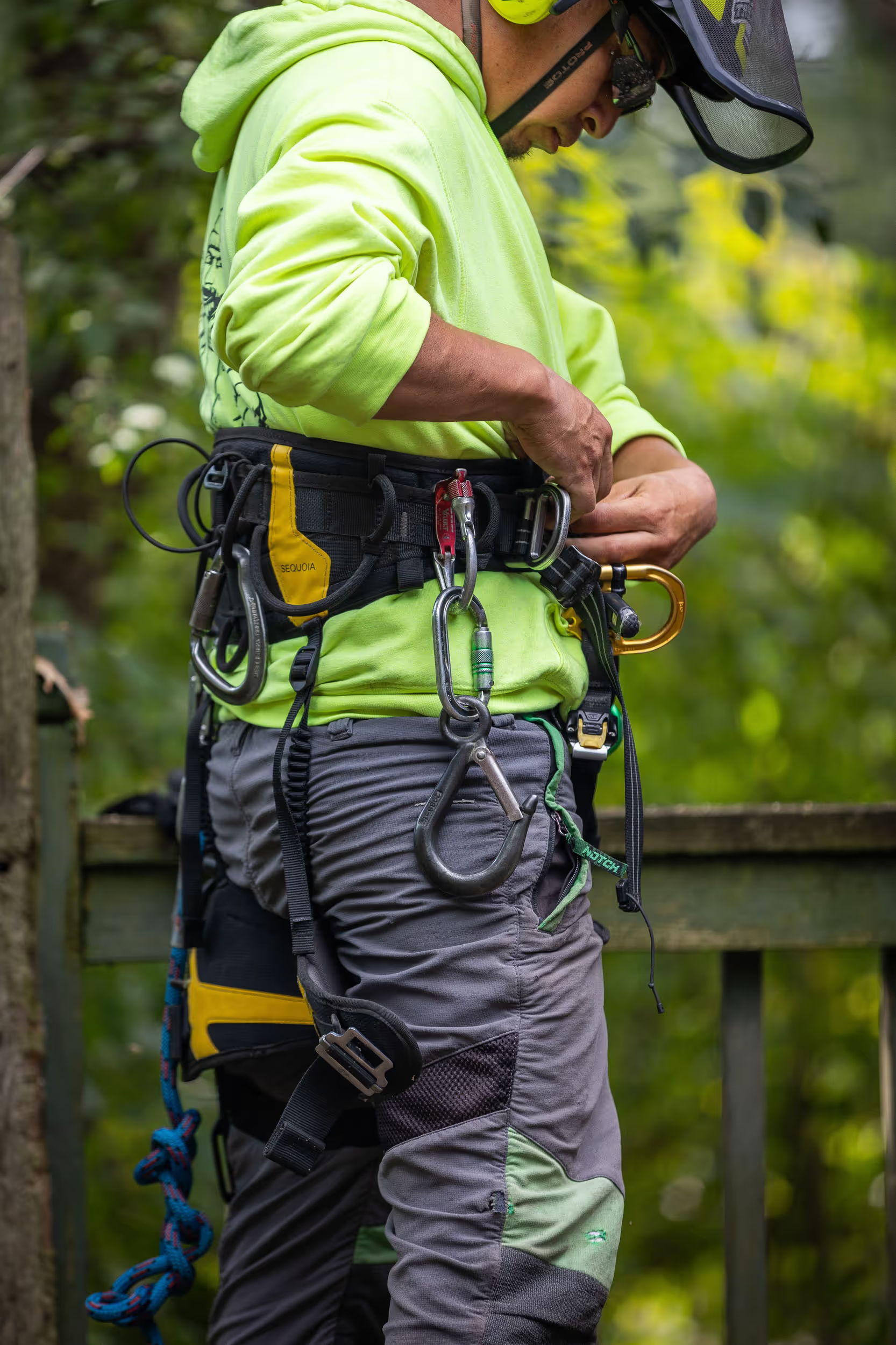
Tree Wise Men LLC has been operating commercially in Rock County since 2010. Our headquarters at 4332 E County Rd O in Janesville is where the dispatch happens — same operational base for tree work, commercial accounts, and snow contracts. The 30-person crew, the heavy equipment fleet, and the TCIA Accreditation are all real and verifiable.
For HOA boards: this matters because a snow contractor who walks away mid-season — over-commitment, financial collapse, equipment failure they can't replace — leaves the association scrambling for emergency service in January at peak pricing. A year-round operation with multiple revenue streams doesn't face that pressure.
For HOA quote requests, call directly: (608) 751-4171.
Tree & Property Services Across Janesville & Rock County
Explore our other Janesville-specific tree care pages — each covers the local permits, species, and neighborhood access that matter for your property.
What Homeowners Say About Us
4.9 stars across 988 Google reviews of our Janesville, Madison, and Fort Atkinson crews — pulled live from Google, not hand-picked.

They did an excellent job and were great to work with. I would definitely have they back again.
Kathy Steinborn
in the last week · Janesville HQ listing
They were prompt on the day of service and they checked with me before doing any of the trimming to make sure everyone was on the same page. Efficient and cleaned up the area well after trimming four different trees. Highly recommend.
Jason Stuckey
in the last week · Janesville HQ listing
The team did all we asked in a reasonable time. Clean up was excellent.
Connie Veale
in the last week · Janesville HQ listing
Snow Removal Across Rock County
We plow Janesville, Beloit, Milton, Edgerton, Evansville, Clinton, Orfordville, and the townships between them from our Janesville headquarters. Snow and ice management is a Rock County service — our Madison and Fort Atkinson offices handle tree care only.
HOA Snow FAQs
Common questions from HOA boards and association property managers.
What HOA snow removal services do you provide in Rock County?
Full HOA snow programs across Rock County: private road and cul-de-sac plowing, common-area sidewalk clearance, individual driveway routes when included in the HOA scope (some associations contract driveways centrally, others leave them to homeowners), clubhouse and amenity-area service, mailbox cluster access, dumpster pad clearance, ice management on common-area surfaces and ADA pathways, and seasonal snow stake placement on association property lines.
How are HOA snow contracts typically structured?
Two common structures. (1) Seasonal flat-rate — fixed monthly fee November through March covering unlimited service events at the contracted trigger depth. Predictable budget line for the association, simplifies board reporting. (2) Per-event with annual cap — billed per service occurrence with an annual maximum that protects the association from runaway heavy-snow seasons. The right structure depends on the board's risk tolerance and the association's historical snowfall exposure.
What documentation will my HOA board need from a snow contractor?
Standard board-required documentation: Certificate of Insurance naming the HOA as certificate holder (general liability + workers' compensation), a written scope of work specifying which surfaces are included, the trigger depth and response SLA, the ice management protocol (salt vs sand vs brine, walk-behind treatment specifics), references from other Rock County HOA contracts, and time-stamped service documentation for each event so the board can verify performance. We provide all of the above as standard.
How do you handle communication with HOA boards and property managers?
Direct contact with the designated board liaison or property manager (whoever the association assigns). We provide monthly service reports during the season, real-time event notifications for storms exceeding 6 inches or sub-zero conditions, and an on-call number for board members during major events. For property-managed HOAs, all communication flows through the property manager unless the board specifies otherwise.
When should our HOA board sign a snow contract for the 2026-2027 season?
Most Rock County HOAs sign by September 30 for the November-March season. The timeline that works for boards: solicit RFPs or quotes in July-August, board votes in August or September, contract execution by end of September, pre-season site walk and route documentation in October, season starts November 1. Boards waiting until October or November face pricing increases and route-availability constraints. We hold quote pricing through August as standard.
What's a fair price range for HOA snow service in Rock County?
Highly dependent on the association's size, road miles, sidewalk linear footage, common-area surfaces, and whether individual driveways are in scope. Rough ranges: small associations (under 20 units, no private roads) typically $4,000-$10,000 seasonal. Mid-size associations (20-60 units, private cul-de-sacs, common-area sidewalks) $10,000-$30,000 seasonal. Large associations with extensive private roads and amenities often $30,000-$80,000+ seasonal. Per-inch and per-event structures available. Site walks are free.
Do you handle salt-restricted associations or environmentally-aware HOAs?
Yes. Some Rock County HOAs have covenants restricting salt application (often due to proximity to wetlands, ponds, or salt-sensitive landscaping). We accommodate with sand-only treatment, low-salt sand blends, calcium-magnesium acetate (more expensive but environmentally preferable), or surface-specific protocols that use salt only on liability-critical surfaces (ADA entries) and sand elsewhere.




Get a Board-Ready Quote
Site walks scheduled now through September. We send written quotes, COI, sample contracts, and references your board can verify. Pricing locked through August.