
Certified Arborist Madison WI
A certified arborist in Madison for oak wilt, emerald ash borer, and written risk assessments. Founder Jason James holds ISA credential WI-1418A. Estimates are walked from our Madison office at 2909 Landmark Pl — not sold over the phone.
Financing available — low monthly payments
Direct answers
Decision answers for topping, oak wilt, and emerald ash borer. Treatment ranges are the ones already published on the Dane County guides.
Is topping trees ever OK?
No — topping cuts the crown back to stubs, and it is not an accepted practice under ANSI A300. The stubs decay, and the sprouts that shoot back are weakly attached and more likely to fail in a storm. When a tree is too tall for the site, use a proper reduction cut back to a lateral branch, cable a weak union, or remove the tree. Tree Wise Men does not top trees in Madison or anywhere else.
Should I treat oak wilt or remove the tree in Madison?
It depends on the oak and how far the wilt has gone. Red, black, and pin oaks with active wilt rarely recover and usually need removal after a root-graft barrier is planned. White and bur oaks decline more slowly and can often be held with propiconazole injection while the crown is mostly intact; once more than about a third of the crown is gone, removal is the honest call. Prune live oaks only from November through March unless a storm-broken limb has to come down immediately.
Should I treat an ash tree for emerald ash borer or remove it?
Treat a Dane County ash with emamectin benzoate trunk injection if canopy dieback is still under about 30%. The published rate is $8 to $15 per inch of trunk diameter every 2 to 3 years, about $160 to $300 per cycle for a 20-inch ash. Removing that same tree often runs $1,500 to $3,000 or more, plus stump grinding. Past about 30% canopy loss, injection will not bring the tree back, and removal is the safer spend.
What Does a Certified Arborist Do That a Tree Service Doesn't?
Anyone with a truck and chainsaw can call themselves a tree service. A certified arborist is a trained tree care professional who has passed the International Society of Arboriculture (ISA) exam and maintains continuing education in tree biology, safety, and best practices. Here's what sets certified arborists apart:
Diagnostic Expertise
Arborists identify diseases like oak wilt, Dutch elm disease, and bacterial leaf scorch before they become fatal. Early diagnosis in Madison's dense neighborhoods can save entire blocks of trees from spreading infections.
Prescriptive Care Plans
Rather than defaulting to removal, arborists develop treatment plans — trunk injections, soil amendments, structural pruning — that preserve valuable trees. A 100-year-old oak in Nakoma is worth saving when possible.
Risk Assessment (TRAQ)
Our TRAQ-qualified arborists evaluate structural defects, root stability, and failure probability. This is critical in Madison where mature trees overhang homes, driveways, and busy pedestrian areas near campus.
Pruning Science
Certified arborists prune according to ANSI A300 standards — the national benchmark for tree care. Improper pruning (topping, lion's tailing) causes more long-term damage than no pruning at all.
Preservation During Construction
Madison's ongoing development threatens established trees. Arborists create tree protection zones, root-pruning plans, and post-construction care programs that keep trees alive through building projects.
Legal & Insurance Reports
Arborist reports carry professional weight for insurance claims, neighbor disputes, real estate transactions, and City of Madison tree-related permits. Our written assessments meet industry documentation standards.
Why Madison's Urban Canopy Needs Certified Care
Madison consistently ranks among the best-canopied cities in the Midwest. The mature oaks along Regent Street, the towering elms in University Heights, the sugar maples lining Nakoma's streets — these trees define Madison's character. But that canopy faces serious, compounding threats.
When the prescription is pruning rather than removal, that visit is tree trimming in Madison: ANSI A300 structural pruning, crown reduction, deadwood, and clearance, with live oaks cut while dormant and outside the April-through-July oak wilt window.
Oak Wilt in Dane County
Oak wilt has been confirmed across Dane County, threatening Madison's extensive red and white oak population. The fungus spreads underground through root grafts between neighboring oaks and above ground via sap-feeding beetles. Proper pruning timing — avoiding April through July — is essential to prevent infection. Treatment versus removal is on the Madison oak wilt page.
Emerald Ash Borer (EAB)
EAB has killed tens of millions of ash trees across the Midwest. Madison's ash population remains vulnerable, and proactive trunk injections of emamectin benzoate every two to three years are the most effective defense for trees worth preserving. The Dane County EAB page covers signs, treatment timing, and when removal is the honest call.
Dense Neighborhood Challenges
Neighborhoods like Maple Bluff, Shorewood Hills, and Nakoma feature mature trees on tight lots — often within feet of homes, sidewalks, and power lines. Managing these trees requires arborists who understand structural pruning, clearance requirements, and neighbor coordination.
Construction and Development Pressure
New infill construction on the isthmus and near-west side regularly damages root zones of established trees. Without arborist-guided protection plans, construction crews compact soil and sever roots, often killing trees within three to five years of project completion.
Where Madison Arborist Work Actually Happens
The same ISA visit covers different problems by neighborhood. Isthmus blocks (Tenney-Lapham, Marquette, Williamson Street) are tight lots in the wind corridor between the lakes. Nakoma, Vilas, and Westmorland are preservation jobs on older west-side oaks. Estate villages have their own foresters.
University Heights
Historic district elms and oaks on the near west side.
Maple Bluff
Lake Mendota village canopy and a village forester.
Shorewood Hills
West of campus, with its own tree ordinance.
Middleton
Pheasant Branch oaks, northwest of Madison.
Verona
Older Main Street canopy south of Madison.
Sun Prairie
East-side ash and downtown shade trees.
Fitchburg
South of the Beltline, mixed older and new lots.
Waunakee
Village-core maples north of Madison.
Isthmus
Tenney-Lapham, Marquette, and the Williamson corridor.
Monona
Southeast shore of Lake Monona. Willows, silver maples, and ash along Monona Drive.
Disease work has its own pages: oak wilt treatment in Madison and emerald ash borer in Dane County. Storm failures go to emergency tree removal in Madison.
Arborist Services for Madison Properties
Comprehensive tree care from ISA Certified professionals who understand Dane County's specific tree species, soil types, and environmental conditions.
Tree Health Assessments
Thorough evaluation of tree vigor, structural integrity, and disease presence. We examine crown density, bark condition, root flare, soil compaction, and signs of internal decay using resistance drilling when indicated. Every assessment includes written recommendations and a prioritized action plan.
TRAQ Risk Assessments
Our Tree Risk Assessment Qualified arborists evaluate the probability and consequences of tree failure. Using the ISA's standardized risk matrix, we assess targets, tree condition, and site factors to determine risk ratings — essential for liability management on Madison properties near homes and public spaces.
Plant Health Care Programs
Customized seasonal programs including deep-root fertilization, targeted pest management, mycorrhizal inoculation, and disease prevention treatments. We monitor your trees throughout the year and adjust treatments based on conditions — not a one-size-fits-all spray schedule.
Disease & Pest Management
Targeted treatment for oak wilt (propiconazole injection), emerald ash borer (emamectin benzoate injection), Dutch elm disease, apple scab, and other pathogens affecting Dane County trees. We use integrated pest management principles, treating only when thresholds warrant intervention.
Cabling & Bracing for Madison's Historic Trees
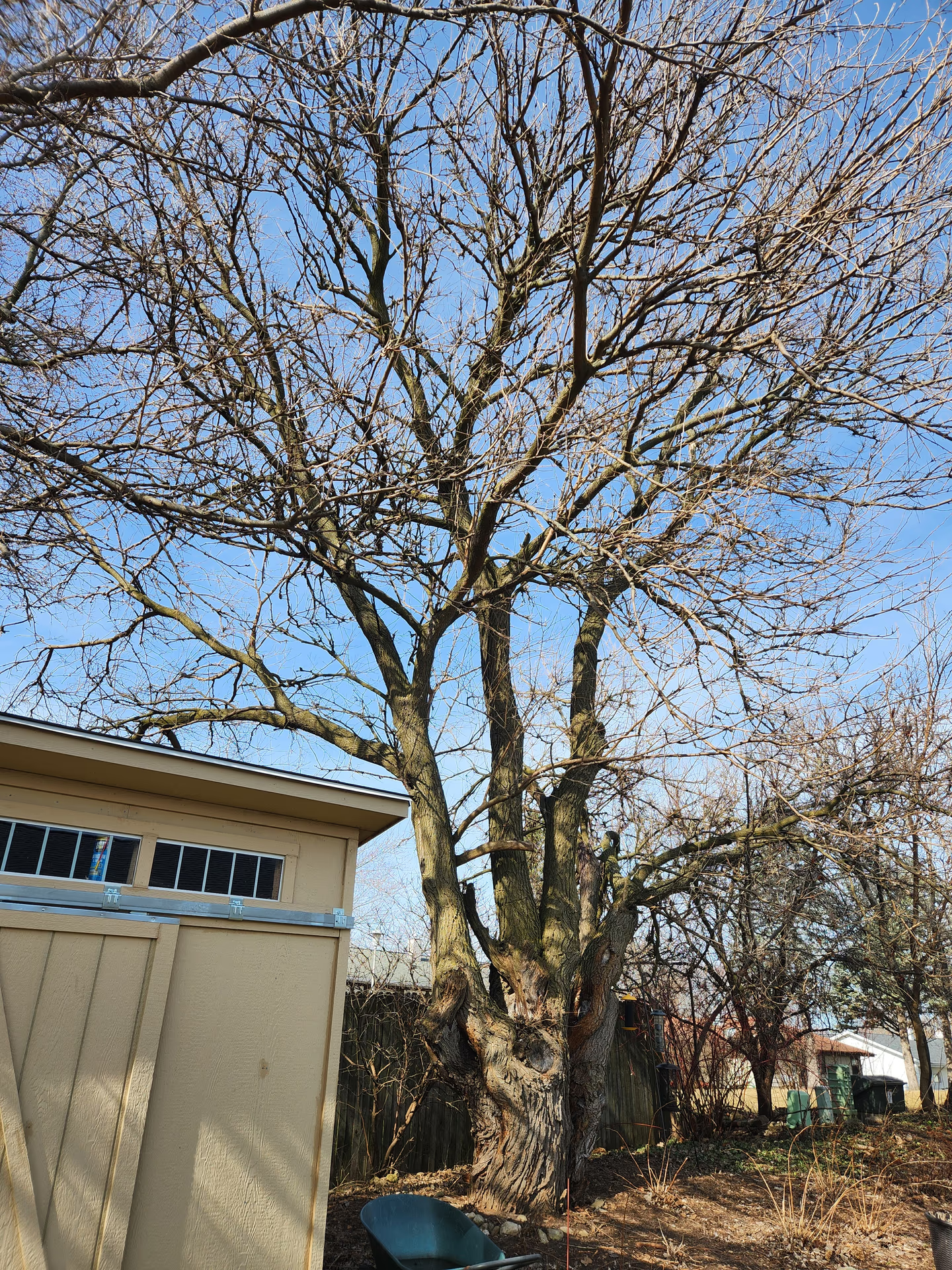
Many of Madison's most valuable trees — century-old oaks in Maple Bluff, towering elms along the lakeshore, and massive silver maples in older neighborhoods — have structural defects that make them candidates for cabling and bracing rather than removal.
Supplemental support systems use high-strength steel cables installed in the upper canopy to reduce strain on weak branch unions. Through-bolts and threaded rods brace split trunks and co-dominant stems. When properly installed by a certified arborist, these systems can extend a tree's safe life by decades.
Our arborists assess each tree's architecture, load factors, and failure history to design support systems that meet ANSI A300 standards for supplemental support. Every installation includes follow-up inspections to ensure long-term effectiveness.
Our Madison Office
Tree Wise Men operates a dedicated Madison office to serve Dane County and surrounding areas. Our ISA Certified Arborists are based locally, providing faster response times and deeper knowledge of Madison's specific tree care challenges.
Call our Madison office directly at (608) 716-4167 or visit us at 2909 Landmark Pl, Suite #215B, Madison, WI 53713.
Tree & Property Services Across Madison & Dane County
Explore our other Madison-specific tree care pages — each covers the local permits, species, and neighborhood access that matter for your property.
Arborist FAQs for Madison
Common questions about certified arborist services in Madison, WI.
What is the difference between an arborist and a tree service?
An arborist is a trained specialist with credentials like ISA Certification, focusing on tree biology, diagnostics, and long-term health. A general tree service may handle cutting and removal but lacks the expertise to diagnose diseases, prescribe treatments, or develop plant health care plans. Tree Wise Men employs multiple ISA Certified Arborists who bring science-based care to every job in Madison.
Why does Madison need certified arborists specifically?
Madison's dense urban canopy — mature oaks, elms, and maples in neighborhoods like Nakoma, Maple Bluff, and Shorewood Hills — faces unique pressures from oak wilt, emerald ash borer, Dutch elm disease, and construction damage. Certified arborists understand Dane County's specific tree health challenges and local ordinances governing tree care and removal.
What is a TRAQ assessment and when do I need one?
TRAQ stands for Tree Risk Assessment Qualification, an advanced ISA credential. A TRAQ assessment evaluates a tree's structural integrity, root stability, and likelihood of failure. Madison homeowners often need TRAQ assessments for large trees near homes, trees showing signs of decay, or when planning construction that may affect root zones.
How much does an arborist consultation cost in Madison?
At Tree Wise Men, we provide free on-site estimates for tree work. For detailed written arborist reports — needed for insurance claims, real estate transactions, or legal disputes — fees vary based on scope. Call our Madison office at (608) 716-4167 for specifics.
Can you treat oak wilt in Dane County?
Yes. Oak wilt is a serious fungal disease confirmed throughout Dane County. Our arborists use propiconazole trunk injections for high-value red oaks and establish root-graft barriers to prevent underground spread to neighboring trees. Early detection and treatment are critical — once canopy loss exceeds 30%, treatment success drops significantly.
Do you provide plant health care programs for Madison properties?
Absolutely. Our plant health care programs include seasonal deep-root fertilization, targeted pest and disease treatments, soil analysis, and ongoing monitoring. We customize each program based on the specific tree species, soil conditions, and environmental stressors on your Madison property.
Which ISA credential signs Madison estimates?
Founder Jason James is an ISA Certified Arborist, credential WI-1418A. Tree Wise Men also employs other ISA Certified Arborists who walk estimates from the Madison office at 2909 Landmark Pl. Call (608) 716-4167 or book online for a free consult.



2026 guide
Structural support for a heritage tree: what cabling and bracing cost in Madison, designed to ANSI A300 Part 3.
Talk to a Certified Arborist in Madison
Schedule a free on-site consultation with our ISA Certified Arborists. We'll assess your trees, answer your questions, and provide expert recommendations — no obligation.