
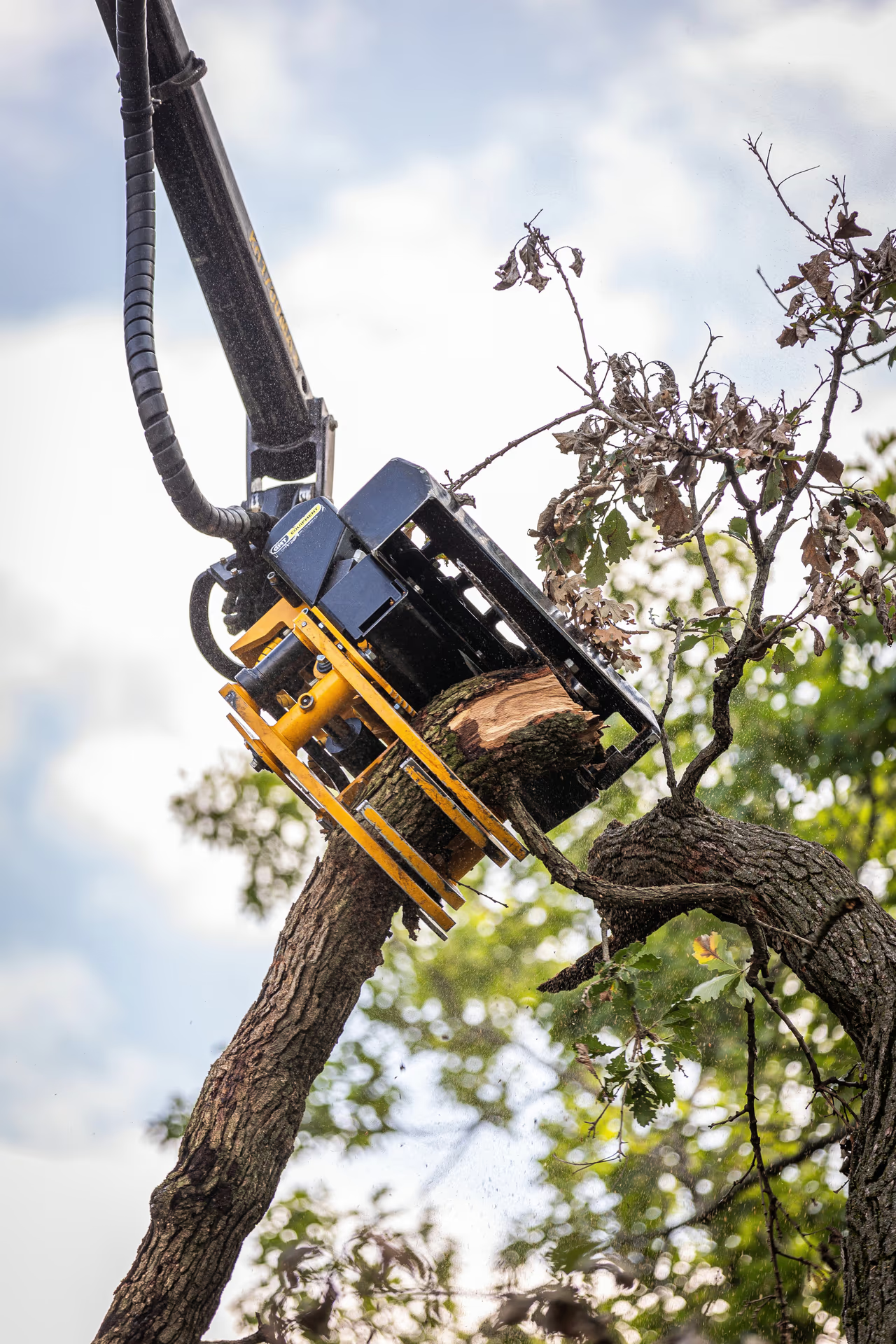
Tree Trimming & Pruning in Madison, WI
Expert tree trimming and pruning across Madison and Dane County. Our ISA Certified Arborists follow ANSI A300 industry standards to protect mature canopy trees in the isthmus, near-east, near-west, and Madison's wooded estate neighborhoods — from heritage oaks to ornamental and fruit trees.
Financing available — low monthly payments
What's the Difference Between Tree Trimming and Tree Pruning?
In the tree care industry the two words are often used interchangeably — both refer to selective branch removal — but they carry slightly different intent, and Madison homeowners search for both terms with different expectations. Knowing the distinction helps you ask for the right scope of work.
Tree Trimming
Often used to describe aesthetic and clearance work — shaping the canopy, clearing branches away from rooflines, sidewalks, driveways, sight lines, and utility lines, and maintaining a desired form. Frequency: typically every 2 to 5 years on mature trees.
Examples: crown raising over a Vilas sidewalk, clearing branches off a Maple Bluff garage, tidying a fruit tree in Westmorland.
Tree Pruning
Often used to describe arboricultural and health-driven work — improving tree structure, removing dead or diseased wood, reducing wind sail, correcting weak branch attachments, and following ANSI A300 standards for long-term canopy health. Frequency: structural pruning every 5 to 10 years on heritage canopy.
Examples: structural pruning of a young University Heights oak, crown cleaning on a Shorewood Hills sugar maple, deadwood removal on a Spring Harbor heritage elm.
Either way, the same ISA Certified Arborist visits your property. We assess what your trees actually need, recommend the appropriate scope (often a mix of trimming and pruning), and follow ANSI A300 cut-placement standards either way. The label matters less than whether the person doing the work understands tree biology.
Why Proper Pruning Matters for Madison Trees
Madison has been a Tree City USA for over four decades, and Dane County contains some of the most valuable urban and estate-grade tree canopy in Wisconsin. Improper trimming — topping, lion-tailing, flush cuts, and over-pruning — causes irreversible damage to trees that often took a century to mature. Our ISA Certified Arborists follow science-based pruning practices that protect long-term tree health, structural integrity, and property value.
Heritage Tree Care in Estate Neighborhoods
Maple Bluff, Shorewood Hills, University Heights, and Nakoma have specimen trees that are 100+ years old and individually valued in the tens of thousands of dollars. These mature oaks, beeches, and maples need careful crown cleaning, structural assessment, and weight reduction — not aggressive cutting. We preserve the architecture that took generations to develop.
Oak Wilt Pressure Across Dane County
Dane County has significant oak wilt activity, particularly around the lake basins and wooded estate properties. We prune oaks only during the safe dormant window (November through March) when sap beetles are inactive. Pruning oaks outside this window risks fatal fungal infection that can spread through root grafts to neighboring oaks within weeks.
Isthmus & Near-East Tight-Lot Pruning
Properties in Marquette, Tenney-Lapham, Schenk-Atwood, and the surrounding near-east neighborhoods often have mature canopy on lots too tight for bucket trucks. We use climber-rigged technique, compact tracked lifts, and careful adjacent-property protection to prune safely without damage to fences, sheds, or neighboring landscapes.
Lakeshore & Storm-Exposed Properties
Homes along Lake Mendota and Lake Monona — especially in Maple Bluff, Vilas, and the Atwood corridor — face wind and ice loading that interior properties don't. Preventive structural pruning, deadwood removal, and weight reduction reduce the risk of storm-driven branch failure on lakeshore trees with extensive sail area.
Fruit & Ornamental Tree Care
Apple, pear, cherry, and crabapple trees throughout Madison need annual pruning for fruit production and aesthetic shape. Late winter (February–March) is the ideal pre-bud-break window in Dane County. Ornamental species like Japanese maples, flowering dogwoods, and serviceberries need species-specific pruning that preserves their natural form.
Coordination With Madison Forestry
Trees in the City of Madison terrace (the strip between sidewalk and street) fall under the jurisdiction of Madison Forestry, and any work requires a permit and approved contractor. We handle all permit research and coordination so your terrace tree work is fully compliant with City rules.
Types of Professional Pruning We Perform in Madison
Crown Cleaning
Removal of dead, dying, diseased, and broken branches throughout the canopy. The most common and most important pruning type — it reduces pest habitat, eliminates branches likely to fall during Madison's spring and summer storms, and is appropriate for any species in any season. Recommended every 3 to 5 years for mature shade trees.
Crown Thinning
Selective removal of interior branches to increase light penetration and air circulation without changing the tree's overall form. Reduces wind resistance during the high-wind events common across the Dane County plains, helps prevent fungal disease in humid summers, and promotes healthy interior growth.
Crown Raising
Removal of lower branches for clearance over sidewalks, driveways, vehicles, and rooflines. Frequently needed along Madison's tree-lined streets — Vilas, Westmorland, Tenney-Lapham — where mature canopy has grown to obstruct pedestrians or sight lines. We maintain proper branch-to-trunk ratios to preserve tree stability.
Structural Pruning
Correcting branch architecture in young and maturing trees to develop strong structure. We identify and address co-dominant stems, included bark, and weak attachments before they become structural failures in mature trees. Particularly valuable for trees planted in newer Madison developments — Bishops Bay, Sun Prairie boundary, west-side subdivisions — where early intervention pays off for decades.
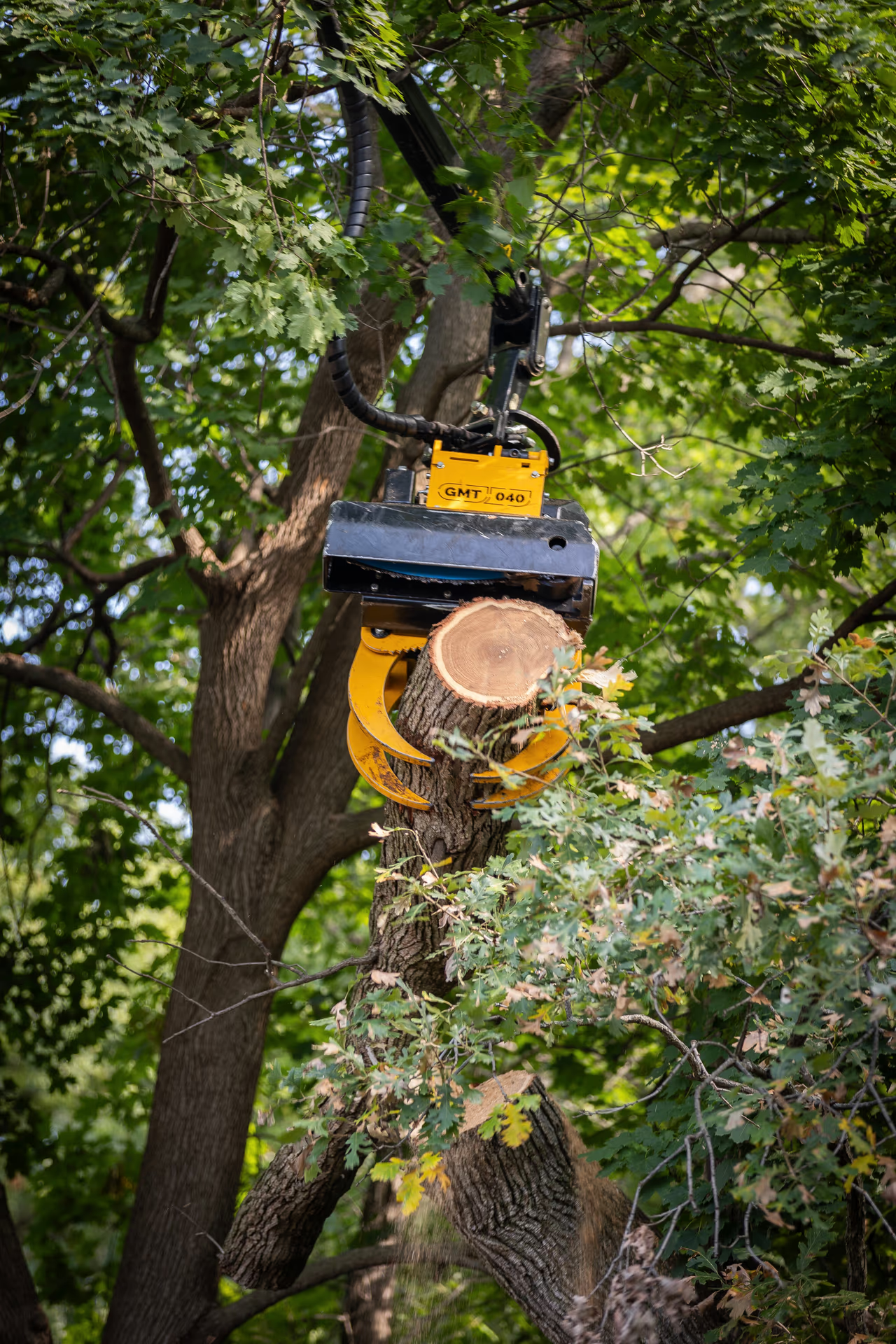
Crown Reduction vs. Topping: Know the Difference
Many Madison homeowners are pitched topping by unqualified companies. Topping is malpractice — it destroys trees and creates years of expensive structural problems. Here's how our ISA Certified approach is different.
Proper Crown Reduction
Cuts are made back to lateral branches at least one-third the diameter of the branch being removed. The tree retains its natural form, wound closure proceeds efficiently, and any regrowth is structurally sound. Canopy size decreases without compromising the tree's health, vigor, or long-term integrity.
Why Timing Matters in Dane County
Pruning during the dormant season (late November through March) reduces stress, minimizes sap loss, and avoids the insect-vectored diseases — especially oak wilt — that are active in Dane County during the warm months. We schedule each species at its optimal window, even when that means returning to a property in a different season.
The Science Behind Pruning Cuts
Every pruning cut is made just outside the branch collar — the slightly swollen ring where branch meets trunk. This preserves the tree's natural defense zone (the chemical and structural barrier the tree uses to wall off injury) and allows the wound to seal properly. Flush cuts and stub cuts both compromise this defense, leading to internal decay that may not become visible for years.
Annual Maintenance Programs
For Madison properties with multiple mature trees, we offer annual maintenance programs that cycle through your trees on a species-appropriate schedule. Regular professional pruning extends tree life, reduces storm damage risk, and maintains property values. Estate properties in Maple Bluff, Shorewood Hills, and Nakoma typically schedule us on a one- or two-year rotation.
Tree Trimming Cost in Madison, WI
Pruning is priced by the size of the tree, how much of the canopy needs work, and how hard it is to reach — not by the hour. These are the ranges Madison and Dane County homeowners typically see from us; every estimate is free, written, and done on site by an ISA Certified Arborist.
| Tree & work type | Typical Madison cost | Notes |
|---|---|---|
| Small ornamental or fruit tree | $150 – $400 | Crabapples, serviceberries, Japanese maples; late-winter pruning window |
| Medium shade tree (25–50 ft) | $400 – $900 | Crown cleaning or raising on maples, lindens, honeylocusts along Vilas and Westmorland streets |
| Large mature oak or maple (50 ft+) | $900 – $1,800 | Crown cleaning, thinning, or reduction; oaks only Nov–Mar for oak wilt |
| Estate specimen work | $1,800+ | Heritage trees in Maple Bluff, Shorewood Hills, University Heights — weight reduction, cabling and bracing |
Wondering whether the tree is worth pruning at all? Compare with tree removal costs in Madison — for a declining ash or a structurally failed silver maple, removal is often the better long-term spend.
What moves a Madison pruning quote
- Canopy sizePrice scales with how many cuts, at what height, over what — a 70-foot oak over a Nakoma roofline is a rigging job, not a trim.
- AccessIsthmus lots too tight for a bucket truck are climbed and rigged by hand; drive-up access on the west side is cheaper.
- SeasonOaks are pruned only in the dormant window to prevent oak wilt; scheduling in Nov–Mar also avoids the summer storm-season premium.
- Terrace treesStreet-side trees belong to Madison Forestry — we handle the permit; it adds lead time, not cost.
- Multi-tree programsEstate properties on a one- or two-year rotation get program pricing across the whole property.
Madison's Tree Trimming Specialists
Tree Wise Men LLC has been trimming and pruning trees across Madison and Dane County since 2010. With 4 ISA Certified Arborists on staff, full TCIA accreditation, and a 30+ person crew operating from our Janesville headquarters and Madison area office, we have the expertise and capacity to maintain trees of any size on any property — from Vilas bungalows to Maple Bluff estates.
Call our Madison office at (608) 716-4167 for fast scheduling, or stop by 2909 Landmark Pl on the south side.
Tree & Property Services Across Madison & Dane County
Explore our other Madison-specific tree care pages — each covers the local permits, species, and neighborhood access that matter for your property.
What Madison-area Homeowners Say About Us
4.9 stars across 946 Google reviews of our Janesville, Madison, and Fort Atkinson crews — pulled live from Google, not hand-picked.

They did a great job! The crew was friendly and the cleaned up after themselves. Couldn't ask for a better experience!
Michael Stewart
in the last week · Fort Atkinson listing
The employees at Tree Wise Men were friendly, professional, safety conscious and neat. The price was the best out of 5 quotes that we received. Their communication was timely and informative. I highly recommend this business!
Jennifer Roth
in the last week · Fort Atkinson listing
The work was very good . My issue was with communication.
Jodi Galinsky
in the last week · Fort Atkinson listing
Tree Trimming FAQs for Madison
Common questions about tree trimming and pruning in Madison, WI.
Who does tree trimming and pruning in Madison, Wisconsin?
Tree Wise Men LLC provides ANSI A300 tree trimming and pruning across Madison and Dane County from our Madison office at 2909 Landmark Pl. Our 4 ISA Certified Arborists handle structural pruning, crown reduction, crown thinning, deadwood removal, and oak-wilt-safe pruning timing for the heritage canopy in University Heights, the isthmus, Maple Bluff, and Shorewood Hills. We're TCIA Accredited, never top trees, and carry 800+ five-star reviews. Call (608) 716-4167 for a free estimate.
When is the best time to trim trees in Madison?
Most deciduous trees in Madison are best pruned during the dormant season — late November through March — when branch architecture is visible and disease transmission risk is lowest. Oak trees in Dane County must only be pruned during this window to prevent oak wilt; cuts made between April and October expose fresh wounds that attract sap beetles carrying the fungus. Spring-flowering ornamentals like crabapples and lilacs should be pruned immediately after they bloom. Deadwood removal and emergency hazard pruning can be performed any time of year.
Do I need a permit to trim a tree in Madison?
The City of Madison Forestry Division has jurisdiction over terrace trees (the strip between sidewalk and street) and any work on public trees requires a permit issued through the City. Pruning trees on private property generally does not require a permit, though some historic districts and Maple Bluff or Shorewood Hills properties may have neighborhood covenants. Our team handles permit research and coordination with Madison Forestry as part of any job involving terrace or boulevard trees.
Why is oak pruning so risky in Madison and Dane County?
Dane County has significant oak wilt pressure, particularly in oak-heavy neighborhoods like Maple Bluff, Shorewood Hills, and the wooded areas surrounding the lakes. Oak wilt is a fatal fungal disease spread by Nitidulid sap beetles attracted to fresh pruning wounds during the warm months. The safe pruning window for any oak species in Madison is November through March, when sap beetles are dormant and the fungal spores are inactive. We never prune oaks outside this window unless it's an emergency hazard situation, and we use sealant on any wounds that occur during the unsafe window.
How much does tree trimming cost in Madison, WI?
Tree trimming in Madison typically ranges from $300 for small ornamental trees to $1,800+ for mature canopy trees requiring crane access, lift trucks, or extensive deadwood removal. Pricing varies with tree size, species, scope of work, and access difficulty — isthmus and near-east properties with tight rear yards or no driveway access often require more rigging and can cost more. We provide free on-site estimates with detailed written proposals so you understand exactly what work is recommended and why.
Can you handle large trees on the Madison isthmus?
Yes. The isthmus, near-east, and near-west sides of Madison have many properties with mature canopy trees — often 80 to 150 years old — on lots too tight for traditional bucket truck access. We use climber-rigged techniques, compact tracked lifts, and crane-assisted pruning when conditions require it. Our crews regularly work in University Heights, Tenney-Lapham, Marquette, Vilas, and other neighborhoods where access is constrained and adjacent property protection is critical.
What is ANSI A300 pruning, and why does it matter?
ANSI A300 is the national standard for tree care operations, established by the Tree Care Industry Association. It governs cut placement (just outside the branch collar), maximum canopy removal in a single session (never more than 25%), and the objectives of each pruning type. Companies that don't follow A300 standards often top trees, make flush cuts, or leave stubs — all of which cause decay, structural failure, and shortened tree life. Tree Wise Men is TCIA Accredited and our 4 ISA Certified Arborists follow A300 on every job in Madison.
Do you trim trees in Maple Bluff and Shorewood Hills?
Yes, regularly. The mature estate properties in Maple Bluff and Shorewood Hills have some of the most valuable urban canopy in Dane County — many properties have specimen oaks, beeches, and maples worth tens of thousands of dollars individually. We perform crown cleaning, deadwood removal, structural pruning, and weight reduction tailored to estate-grade tree care, with full coordination of any village permits and tree board requirements.


Need Tree Trimming or Pruning in Madison?
Get a free on-site consultation with an ISA Certified Arborist. We'll evaluate your trees, recommend the right pruning approach, handle any Madison Forestry permits, and provide a detailed written estimate with no hidden fees.