Tree Trimming Cost in Madison, WI (2026 Pricing Guide)
Tree trimming pricing in Madison is harder to pin down than tree removal pricing for a simple reason: trimming a tree isn’t a single product. It’s a category. Crown cleaning, crown thinning, crown raising, structural pruning, weight reduction, and cabling-eligible heritage work are all done with the same crew and the same equipment, but they represent completely different amounts of labor and different objectives. A quote that just says “trim tree, $850” tells you almost nothing.
This is a working pricing guide for tree trimming and pruning in Madison and Dane County in 2026, written by an ISA Certified Arborist. The numbers are real ranges we’re quoting this year, the cost drivers are what we actually calculate against, and the last section explains how to read a trimming quote so you can compare two estimates on the same job fairly.
2026 size and scope brackets for Madison tree trimming
The dominant variables are tree size, the type of pruning specified, and access. For a single-tree job done to ANSI A300 standards by an ISA Certified Arborist:
- Small ornamentals (under 25 ft): $200 to $500. Crabapples, Japanese maples, dogwoods, young magnolias, fruit trees. Usually a half-day single-climber job. Cleanup is the time-consuming part.
- Medium shade trees (25 to 50 ft): $400 to $1,100. Mid-life maples, ash, birch, smaller oaks. Bucket truck or climbing, depending on access. Crown cleaning on a healthy mid-size maple usually lands around $550 in our Madison work.
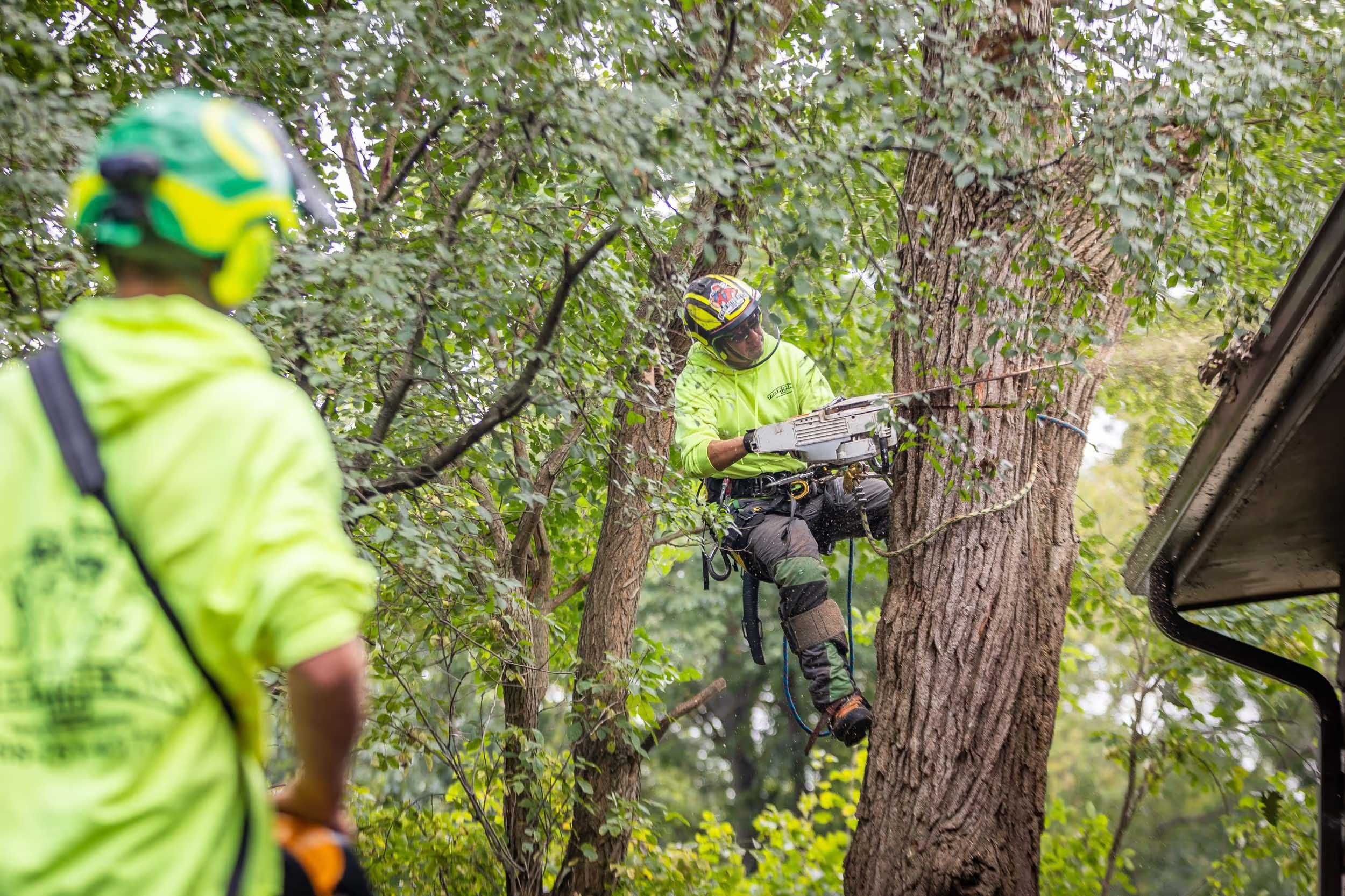
- Large shade trees (50 to 75 ft): $1,100 to $2,800. Mature silver maples, red oaks, lindens, established sugar maples. Climbing-rigged or compact-lift work, often a full day. Structural pruning at the higher end if the tree carries significant deadwood or needs cabling assessment.
- Heritage canopy (75+ ft, century-old specimens): $2,500 to $8,000+. Maple Bluff bur oaks, University Heights heritage sugar maples, Shorewood Hills white pines. Almost always involves a bucket truck or spider lift. Estate-grade preservation work, often scheduled on multi-year rotations rather than one-off cuts.
These are clean-access ranges. Add the modifiers below for the actual quote.
What pruning type drives the price more than size
Crown cleaning
Removing dead, dying, diseased, and broken branches throughout the canopy. This is the most common pruning service and the lowest-cost-per-hour of canopy work. A crew can often complete a 50-foot maple in half a day. Recommended every 3 to 5 years on mature shade trees, more often on heritage specimens with frequent deadwood drop.
Crown thinning
Selective interior branch removal to increase light penetration and reduce wind sail. More time-intensive than cleaning because the cuts are species-specific and based on branch hierarchy decisions. Done correctly, you can’t tell the tree was thinned. Done incorrectly (lion-tailing), it kills the tree slowly. Pricing typically runs 25 to 50 percent above cleaning.
Crown raising
Removing lower branches for clearance over sidewalks, driveways, sight lines, and rooflines. Common along Madison’s mature-canopy streets where 60-year-old shade trees have grown to overhang front lawns. Generally faster than thinning because the decisions are simpler. We maintain proper branch-to-trunk ratios to preserve stability.
Structural pruning
Correcting branch architecture in young to mid-aged trees to develop strong long-term structure. Identifies and removes co-dominant stems, included bark, and weak attachments before they become structural failures on a mature tree. This is the highest long-term-value pruning we do — a $400 structural prune at year 10 can prevent a $6,000 removal at year 40. Pricing on young trees is modest ($150 to $500 per tree) but the time per cut is high.
Cabling and bracing assessment
For heritage trees with structural defects (co-dominant stems, heavy lateral limbs), steel cabling and threaded-rod bracing can extend service life by decades. Cabling installation runs $400 to $1,200 per system depending on cable size and span. We assess candidacy on heritage trees in Maple Bluff, Shorewood Hills, University Heights, and Spring Harbor regularly.
What pushes a Madison trimming quote up or down
Access
Isthmus and near-east properties (Marquette, Tenney-Lapham, Schenk-Atwood) often have mature canopy on lots too tight for bucket truck access. Climber-rigged work and compact tracked lifts add labor hours. Add 20 to 40 percent versus an open suburban lot. Lakefront work on Mendota or Monona with bank access constraints similarly adds time.
Permit-managed trees
Trees in the City of Madison terrace require coordination with Madison Forestry. We handle the permit research and submission. Historic district properties may have additional review. Permits don’t add much price but they can add a week to the schedule.
Oak wilt timing
The safe oak pruning window in Wisconsin is November through March. Quotes for oak work outside this window are either emergency hazard work (priced higher because of urgency and sealing requirements) or, in our case, declined until the dormant window opens. Plan oak work in fall for January or February execution.
Cleanup and debris handling
Most quotes include brush chipping and removal. Log handling varies — small-diameter wood is usually chipped, larger sections may be left bucked for firewood by request or hauled. Specify in the contract.
Multi-tree and annual maintenance pricing
Most Madison-area estate and HOA properties get better per-tree pricing on multi-tree jobs because equipment is already staged. A 6-tree maintenance cycle on a Maple Bluff property typically runs 15 to 25 percent below the sum of individual quotes. Annual or biennial rotation programs lock in pricing across years and let us track each tree’s response over time.
How to read two Madison trimming quotes side by side
The single most important comparison is the pruning objective stated in each quote, not the price. If Quote A says “structural pruning, crown cleaning, deadwood removal, weight reduction over the south side” and Quote B says “trim the tree,” you’re not comparing the same work. Force both contractors to specify objectives in writing. The cheaper quote that hides a topping plan will cost you the tree.
The fastest tests on a Madison trimming quote: Does the scope list specific pruning types? Does it cite ANSI A300 standards or equivalent? Is the ISA-Certified Arborist named? Is the COI on file? Anyone who can’t produce all four shouldn’t be on the property.
Where Tree Wise Men prices on this range
We sit in the upper-middle of the Madison market. We’re not the cheapest crew — uninsured operators with one chainsaw and a pickup undercut every reputable company. We’re not the most expensive — the regional chains carry overhead we don’t. We’re a 30-person TCIA Accredited operation with 4 ISA Certified Arborists, headquartered in Janesville with a Madison Area Office at 2909 Landmark Pl, and we quote at the actual cost of doing the work to ANSI A300 with full insurance, written scope, and named arborist supervision.
For a free on-site estimate anywhere in Madison or Dane County, call (608) 716-4167 for our Madison office or visit https://www.treewisemenllc.com/contact-us. We don’t top trees, we put the objectives in writing, and we’ll tell you straight if your tree needs the work you’re asking for or not.