
What HOA Boards Should Ask Before Hiring a Tree Contractor
Written for the volunteer treasurer or property manager collecting three bids before budget night. Copy the checklist into your RFP as-is. This is contractor-selection guidance, not legal advice on your contract.
Why bad RFPs get junk bids
The most common HOA tree RFP we see is a paragraph: “Provide a price for annual tree maintenance of the common areas.” Three bidders read it three ways. One prices a light trim of the trees they can see from the road. One prices everything including the removals that should have been done five years ago. One prices low and plans to bill change orders. The board gets three numbers that have nothing to do with each other, picks the lowest, and finds out in July what it didn't buy.
The fix isn't a longer paragraph. It's an inventory, unit pricing, and a checklist of requirements every bidder has to meet before you open the price column. That's what the rest of this page gives you.
Attach these to the RFP
- Tree inventory. Even a rough one: species, approximate size, location, and any known problems. If you don't have one, ask bidders to walk the property before pricing — and say so in the RFP.
- Scope boundary. Which trees are the association's (common areas, entrances, retention ponds, private roads) and which belong to lot owners. Say how encroaching lot-owner trees over common walkways are handled.
- Priority tiers. What must be handled first after a storm: blocked roads, trees on structures, hazard limbs over walkways, then everything else.
- Communication expectations. Who the contractor reports to, how often, and whether they attend board meetings.
The checklist: require before you open envelopes
Twenty items in five groups. A bidder who can't produce the first two groups shouldn't be in the price comparison at all.
Credentials
- ISA Certified Arborist on staff, named in the bid — not "we have guys who know trees"
- TRAQ (Tree Risk Assessment Qualification) for anyone assessing hazard removals
- TCIA Accreditation, or a written explanation of why the bidder doesn't hold it
- Certified crane operator and CDL drivers if crane work is in scope
Insurance
- General liability certificate — $2 million is the standard we carry and the number worth asking for
- Workers' compensation on every employee (a subcontractor's injury on your common area becomes your problem otherwise)
- Commercial auto on the fleet
- The association named as additional insured, and the certificate verified with the carrier — not just a PDF from the bidder
Standards
- Pruning to ANSI A300 — the industry standard that, among other things, prohibits topping
- Safety to ANSI Z133 — the arborist safety standard
- Oak wilt: no oak pruning April through July at minimum; dormant-season oak work in Dane, Rock, and Walworth infection areas
- EAB protocol if the community has ash: treat-or-remove criteria (the 30% canopy rule) and a schedule
Service and reporting
- A written emergency SLA: hours to site for a blocked road, a tree on a structure, and a hazard limb over a walkway
- A sample board report and before/after documentation from a comparable community
- A named account contact who attends board meetings when asked
- HOA references in Southern Wisconsin you can actually call
Pricing
- Unit pricing, not a lump sum: pruning by size class, removal by size class, stump grinding per stump or per inch, and a storm rate card
- A tree inventory or at minimum a common-area walk before the number — a lump sum with no inventory is a guess
- Clear separation of common-area scope from lot-owner trees
- Multi-year pricing terms if you're signing a maintenance program
A simple scoring matrix
Score every bid on these before anyone looks at the price column. Price matters; it just shouldn't be the only thing that does.
| Criterion | Weight |
|---|---|
| Credentials (ISA, TRAQ, TCIA) | 25 |
| Insurance verified, HOA additional insured | 20 |
| Safety and work standards (A300 / Z133 / oak wilt / EAB) | 15 |
| Reporting, communication, board presence | 15 |
| HOA references, comparable communities | 10 |
| Price (unit pricing, inventory-based) | 15 |
| Total | 100 |
Adjust the weights to your community; keep price under a third.
Red flags
- Topping in their portfolio photos, or "we can top it for you" — ANSI A300 prohibits it for a reason
- No certificate of insurance, or one they won't let you verify with the carrier
- Cash-only, or a big deposit before any work
- "We'll figure out the scope on site" — that's a change order waiting to happen
- Hazard removals proposed by someone with no TRAQ qualification
- A lump sum with no inventory and no size classes
- Oak pruning scheduled for June, or no answer when you ask about oak wilt timing
- No named contact; every call goes to whoever answers the phone
How we work with boards
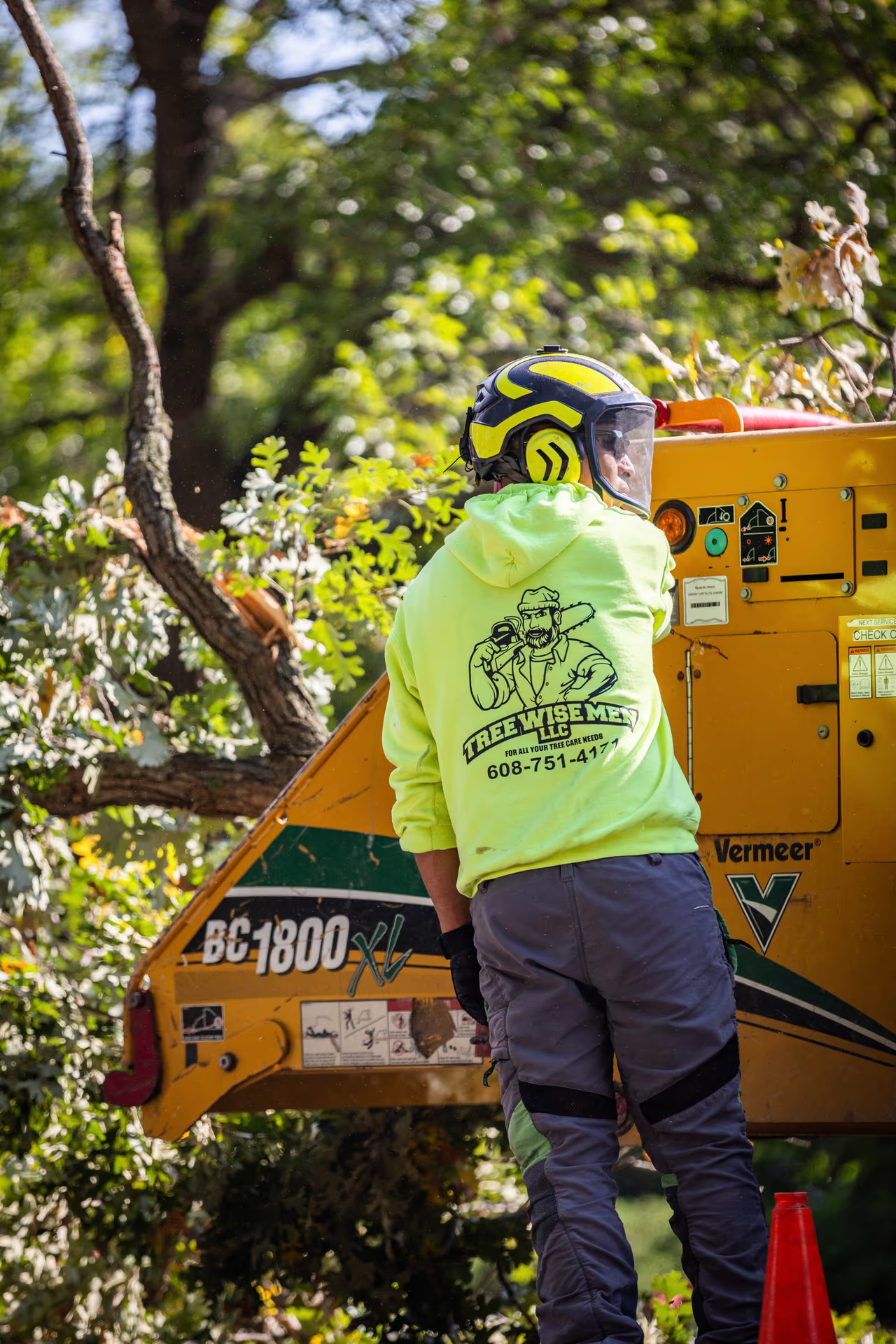
We'd pass every line on this page, and we'd rather you check than take our word for it. Practically, an engagement with us looks like: a common-area walk with the board or manager, an inventory-based proposal with unit pricing and priority tiers, a written storm SLA, a certificate of insurance naming the association within one business day, and an annual report the treasurer can put in the packet. We attend board meetings when asked, and we run snow contracts for Rock County communities under the same accountability.
One-page RFP checklist
Print this section for the board packet- ISA Certified Arborist on staff, named in the bid — not "we have guys who know trees"
- TRAQ (Tree Risk Assessment Qualification) for anyone assessing hazard removals
- TCIA Accreditation, or a written explanation of why the bidder doesn't hold it
- Certified crane operator and CDL drivers if crane work is in scope
- General liability certificate — $2 million is the standard we carry and the number worth asking for
- Workers' compensation on every employee (a subcontractor's injury on your common area becomes your problem otherwise)
- Commercial auto on the fleet
- The association named as additional insured, and the certificate verified with the carrier — not just a PDF from the bidder
- Pruning to ANSI A300 — the industry standard that, among other things, prohibits topping
- Safety to ANSI Z133 — the arborist safety standard
- Oak wilt: no oak pruning April through July at minimum; dormant-season oak work in Dane, Rock, and Walworth infection areas
- EAB protocol if the community has ash: treat-or-remove criteria (the 30% canopy rule) and a schedule
- A written emergency SLA: hours to site for a blocked road, a tree on a structure, and a hazard limb over a walkway
- A sample board report and before/after documentation from a comparable community
- A named account contact who attends board meetings when asked
- HOA references in Southern Wisconsin you can actually call
- Unit pricing, not a lump sum: pruning by size class, removal by size class, stump grinding per stump or per inch, and a storm rate card
- A tree inventory or at minimum a common-area walk before the number — a lump sum with no inventory is a guess
- Clear separation of common-area scope from lot-owner trees
- Multi-year pricing terms if you're signing a maintenance program
Source: Tree Wise Men LLC, TCIA Accredited · treewisemenllc.com/hoa-tree-service-rfp-checklist-wisconsin
What Homeowners Say About Us
4.9 stars across 987 Google reviews of our Janesville, Madison, and Fort Atkinson crews — pulled live from Google, not hand-picked.

They were prompt on the day of service and they checked with me before doing any of the trimming to make sure everyone was on the same page. Efficient and cleaned up the area well after trimming four different trees. Highly recommend.
Jason Stuckey
in the last week · Janesville HQ listing
The team did all we asked in a reasonable time. Clean up was excellent.
Connie Veale
in the last week · Janesville HQ listing
Great crew, had a climber for this job who was masterful. Excellent office staff and billing all electronic. Well organized and seamless process. I highly recommend. Jim
James Davis
in the last week · Madison listing
HOA Tree Contractor FAQs
Contractor-selection guidance, not legal advice on your declaration or contract.
What should an HOA require before hiring a tree service in Wisconsin?
Proof of ISA certification (and TRAQ for hazard assessments), current general liability and workers' compensation insurance with the association named as additional insured and verified with the carrier, work to the ANSI A300 pruning and Z133 safety standards, a written storm-response SLA, sample board reports, HOA references, and unit pricing tied to a tree inventory rather than a single lump sum. Add oak wilt timing and an EAB protocol if the community has oaks or ash.
Why does a lump-sum bid get junk responses?
Because without an inventory, every bidder is guessing at a different scope. The low number is usually the bidder who plans to do the least — or to bill extras once they're on site. Ask every bidder to price the same inventory and size classes, and the bids become comparable. It's the single biggest improvement a board can make to an RFP.
Who pays for a tree on a lot-owner's property that overhangs the common area?
It depends on your declaration and Wisconsin's common-law rules, so the RFP should say which trees are in scope rather than leave it to the crew. Most declarations make lot owners responsible for trees on their lots and the association responsible for common areas, with the association handling the trimming of anything encroaching on common-area walkways or roads. Write the boundary into the scope; a good contractor will flag any tree that's ambiguous before working on it.
What's a reasonable emergency response commitment?
For a community with private roads and walkways, a written commitment to be on site within hours — not days — for a blocked road or a tree on a structure, with hazard limbs over walkways handled the same day. Get the number in writing; "we prioritize our contract customers" is not an SLA.
Should the HOA require TCIA Accreditation?
It's worth asking for. TCIA Accreditation is a third-party audit of a company's safety program, insurance, training, and business practices — fewer than 400 companies nationwide hold it. A bidder without it isn't necessarily unqualified, but they should be able to tell you why, and how they meet the same bar.
How should the board compare the bids?
Score them on a simple matrix before anyone looks at the price column: credentials, verified insurance, standards, reporting, references, and price, weighted so that price is meaningful but not dominant. Then read the low bid twice for what it leaves out. A contractor that scores well everywhere and prices in the middle usually costs the community less over five years than the lowest bid.
Do you present to HOA boards?
Yes. We attend board meetings across Rock, Dane, Walworth, and Jefferson counties, walk the common areas with the board or manager, and bring an inventory-based proposal with unit pricing, priority tiers, a storm SLA, and a sample annual report. The first meeting costs nothing. Call (608) 751-4171 to set it up.
Put us on the agenda
A common-area walk and an inventory-based proposal cost the association nothing. We'll bring the COI, the credentials, and a sample report to the first meeting.